Elongated vs Widebody vs Hybrid Pickleball Paddles: Which Shape Fits Your Game

Elongated vs Widebody vs Hybrid Pickleball Paddles

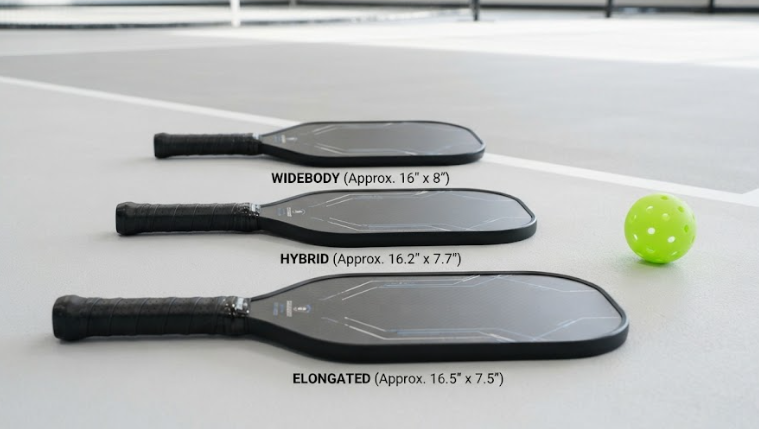
Widebody paddles (about 16″ x 8″) have the biggest sweet spot and the quickest hands at the kitchen. Elongated paddles (about 16.5″ x 7.5″) give up some of that forgiveness for reach, leverage and spin. Hybrids land in the middle. If you’re not sure which you need, start with a hybrid or a widebody. Most players are better off there than with a long paddle, and that includes us tennis converts.

Quick Answers

  • Widebody: largest and most forgiving sweet spot, quickest at the net, least reach. Good for beginners and doubles players who live at the kitchen.
  • Elongated: most reach and leverage on drives, serves and spin, but the least room for off-center hits. Good for singles, big drivers and players with clean contact.
  • Hybrid: a bit more reach than a widebody, a bit more forgiveness than an elongated. The safe pick if you mostly play doubles and can’t decide.
  • The rule behind all of it: USA Pickleball caps paddle length at 17 inches and length plus width at 24 inches. A longer paddle is always a narrower paddle.

Read more

The Two-Handed Backhand in Pickleball: When to Use It, How to Learn It, and Which Paddles Fit

Player hitting a two-handed backhand in pickleball at the kitchen line

The two-handed backhand has gone from a tennis-transplant quirk to a legitimate weapon at the 4.0+ level, and in 2026 it is close to mandatory if you want to survive a kitchen-line firefight. Adding your non-dominant hand gives you stability on fast hands battles, real topspin on the third shot drive, and a roll volley that actually dips.

I need to start with a confession.

For my first two years in this sport, I was a one-handed backhand guy and proud of it. I came from tennis, I had a slice I liked, and I genuinely believed the two-hander was something tennis converts did because they hadn’t bothered to learn a proper pickleball backhand yet. I said this out loud. To people. Repeatedly.

Then I spent about six months getting handcuffed at the kitchen line by a 4.5 who did nothing but speed up at my right hip. Every single time, my one-handed backhand volley would either float or die. He knew it, I knew it, and by the fourth game he had stopped even pretending to hit anywhere else.

That’s when I finally added the second hand. And I want to be honest about the timeline: it made my game noticeably worse for about three weeks, and then it made my game dramatically better forever. If you’re on the fence, that’s the trade you’re actually considering.

Here’s everything I’ve learned since, including the gear mistake that made my first attempt miserable.

Read more

Demystifying Pickleball: Your Top 14 Questions Answered (Before You Even Hit the Court!)

pickleball questions

Pickleball is a beginner-friendly sport that combines tennis, badminton, and ping-pong. Played on a smaller court with a paddle and plastic ball, it is famous for its simple rules—like the underhand serve and “two-bounce” rule—making it accessible and fun for all ages and fitness levels.

So, you’ve heard the buzz. Pickleball. It’s everywhere! Your neighbors are playing it, your local community center just added courts, and even professional athletes are getting in on the action. But maybe you’re feeling a little lost in the sauce, wondering what all the fuss is about. Don’t worry, you’re not alone!

We’ve compiled the 14 most frequently asked questions from curious newcomers like yourself, along with clear, concise, and fun answers to get you up to speed. By the time you finish this, you’ll be ready to grab a paddle and confidently step onto the court!

Read more

Beginner Pickleball Drills: Essential Exercises to Elevate Your Game

Two pickleball players demonstrating a dinking drill in the non-volley zone

To elevate your game, beginners should focus on four core drills: Dinking (for soft control), Volleys (for quick net reactions), Groundstrokes (for baseline consistency), and Serve/Return placement. Practice these weekly to build muscle memory, improve footwork, and develop the consistency needed to win matches.

Pickleball has taken the world by storm, and if you’re new to the court, you’re likely eager to improve your skills. While playing games is undoubtedly the most fun way to learn, incorporating targeted drills into your routine can dramatically accelerate your progress. This article will guide you through essential pickleball drills designed specifically for beginners, helping you build a solid foundation and confidence on the court. If you’re just starting your pickleball journey and need a refresher on the basics, be sure to check out our comprehensive guide: What Is Pickleball?

Read more

How to Handle a Pickleball Ball Hog

Handling a pickleball ball hog starts with communication. Politely setting court boundaries (“Yours vs. Mine”) works for most accidental poachers. For chronic offenders, you may need to let them “run themselves ragged,” employ the “freeze-out” strategy, or simply find a new partner who understands doubles etiquette.

When you’re trying to enjoy a fun game of pickleball, there’s nothing more frustrating than a ball hog teammate who insists on taking every shot, even ones clearly meant for you. Instead of fun rallies, points are over quickly with the ball hog going for shots they had no business going for. We’ve all been there. Personally, there have been times where I will mutter to myself the whole way home that I should have taken control of the situation. So, how can you handle this tricky on-court scenario? We have a few ideas!

Read more

How to Move From a 3.5 to 4.0 Pickleball Rating

It’s a common refrain throughout pickleball, advancing from a 3. 5 to a 4.0 pickleball rating.

While many folks, including yours truly, can consistently win games at local open play sessions against other 3.5 players, we struggle to take that next step up. But there are a few paths you can follow to get your game over the hump. Here’s a look at some of the keys that helped propel my progression.

Read more

How to Stay Light on Your Feet During Pickleball

Staying light on your feet in pickleball is crucial for reaching shots quickly and preventing injury. The key is a combination of proper “split-step” mechanics, improving your lateral agility through drills, and wearing lightweight court shoes that provide stability without weighing you down.

If you feel like your feet are glued to the court when playing pickleball, you’re not alone. Many players, especially those new to the sport, struggle with being light and agile on their feet. This issue, often referred to as “concrete feet,” can significantly hinder your ability to react quickly and get into position for shots. However, you can overcome this challenge with the right techniques and exercises and take your pickleball game to new heights. Here are some tips to help you stay light on your feet when playing pickleball.

Read more

How to Hold a Pickleball Paddle With a Finger-Up Grip

Looking for the standard grips? Check out our Ultimate Pickleball Grip Guide (Continental vs Eastern). This article below specifically discusses the ‘Finger Up’ technique for advanced control.

I don’t play ping pong often, but when I do, I place my index finger on the face of the paddle with a finger-up grip. So perhaps I shouldn’t be surprised that this habit of extending my finger north of the grip carried over to pickleball.

Many pickleball players view this as an unorthodox or even improper way to hold the paddle, but I’ve stuck with it for some time now, and it’s been effective, specifically at the non-volley zone line.

However, the grip comes at a price.

Read more

Cookie Consent with Real Cookie Banner