
Last Updated on March 1, 2026 by Drew Pierce
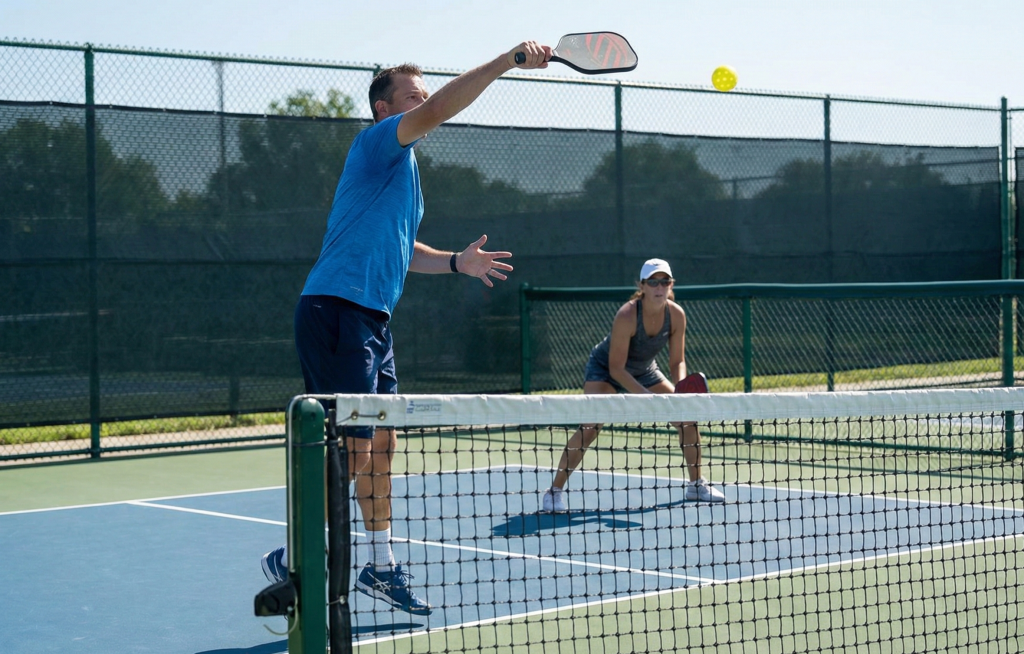
If your opponent is driving your drop shot back at you, your drop shot isn’t “good”—it’s too high. The harsh truth is that a “soft” drop often floats. In 2026, the game has moved beyond the feather-soft dink to the “Drip” (a Hybrid Drive/Drop). To stop the smash, you need to lower your apex, switch from backspin to topspin, and stop rushing the net.
The “I’m Really Good” Fallacy
We see this question all the time: “I have a great drop shot, but they keep driving it back. Why?”
Let’s look at the physics (hat tip to Dan Ewing). A pickleball bounces roughly 50% of the height from which it falls. The net is 34 inches high at the center.
- If your ball clears the net by 2 feet, it is falling from a height of ~5 feet.
- That means it will bounce up to ~2.5 feet (waist high).
- Result: That is a “Green Light” ball for your opponent to crush.
If your “perfect” drop is getting eaten alive, it’s not because your opponent is lucky. It’s because your Apex (the highest point of the arc) is on their side of the net, rather than yours.
Here are the 3 ways to fix it, crowdsourced from the best minds on the court.
1. Stop Dropping. Start “Dripping.”
The days of the high-looping, feather-soft third shot are dying. If you float the ball, a 4.0+ player will step in and roll it at your feet.
The solution is the “Drip” (The Drive-Drop Hybrid). As mentioned by contributors Leexan Hong and Joaquin J. Cruz, the “Drip” is hit with the mechanics of a drive but at 60-70% power.
- The Goal: You aren’t trying to land it softly in the kitchen. You are trying to get it to dip below the net cord the moment it crosses.
- The Spin: This requires Topspin, not slice.
- The Result: Because it has pace, your opponent flinches. Because it has topspin, it dives at their feet. They can’t drive it; they have to block it up.
2. The Spin Debate: Topspin vs. Slice
The comment section on this topic is always a war zone, but the physics don’t lie.
- Backspin (Slice): It travels slower and tends to “sit up” or skid after the bounce. If you float a slice drop, it is a meatball.
- Topspin (The Roll): As Andrew Benk noted, topspin makes the ball dive. It allows you to hit the ball higher over the net (for safety) while still forcing it to drop sharply into the kitchen.
Pro Tip: If you are struggling with high bounces, check your paddle face. If you are “chopping” under the ball, you are likely popping it up. Try “brushing” up the back of the ball instead.
3. The “Transition Zone” Trap
The biggest mistake amateurs make is thinking a Drop Shot is a “Get Out of Jail Free” card that lets them run blindly to the kitchen line.
As Alden Gannon pointed out: “Gone are the days when you can let it bounce in the kitchen and waltz to the line.”
If you hit a mediocre drop, DO NOT RUN.
- Hit the drop.
- Take two steps.
- Split Step.
- Expect the drive.
If you are sprinting while they are hitting, you will get tagged. If you split step, you can block their drive back into the kitchen (the “Fifth Shot Reset”) and then move up.
The Control Freaks: Best Paddles for the “Drip”
To hit a heavy topspin drop that dives at your opponent’s feet, you need a paddle with high dwell time and grit. These are the current leaders in Spin Rate (RPM).
| Paddle | Best For | Why It Helps Your Drop | Price | Link |
|---|---|---|---|---|
| Six Zero Ruby | Max Spin | The Kevlar face grabs the ball like velcro. Ideal for generating the heavy topspin needed for the “Drip.” | $$ | Check Price |
| Selkirk LUXX Control Air | Resetting | A thick 20mm core kills the pace of the ball. If you have “heavy hands” and pop balls up, this paddle fixes it for you. | $$$ | Check Price |
| JOOLA Perseus 3 (16mm) | All-Court | The paddle of choice for Ben Johns. It offers the pop to hit the “Drip” but the control to reset the 5th shot. | $$$ | Check Price |

Drew Pierce is a USA Pickleball Ambassador, PPR certified coach, and tennis crossover who covers beginner tips, paddle releases, and the sport’s growing culture. Read more on his About page or tune into Pickle Rock Radio.