
Last Updated on April 29, 2026 by Drew Pierce
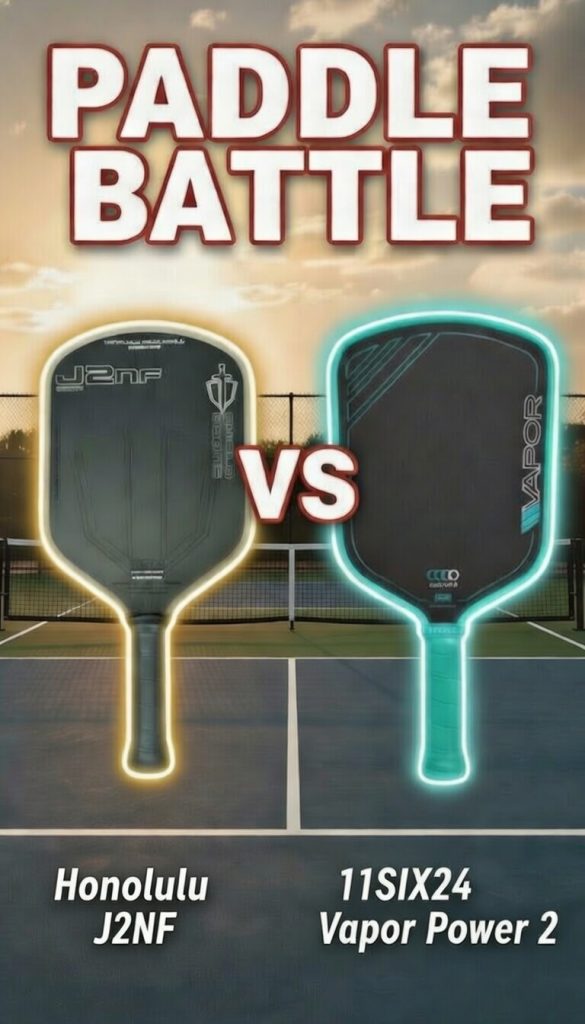
The foam-core revolution is officially here, and it’s getting loud. If you’ve been hanging around the courts lately, you’ve probably heard that deep “thud” of a foam-filled paddle. It’s a completely different feel than the hollow “clack” we’ve all used for years.
Today, I’m putting two of the newest and most hyped 2026 releases against each other. In one corner, we have the Honolulu J2NF, a paddle being hailed as the “Forgiveness King.” In the other, the 11SIX24 Vapor Power 2, a brand-new “value disruptor” that just launched with a surface texture—HexGrit—that looks like it could peel the paint off a car.
I’ve spent the last week rotating between these two in competitive play. While they both use foam, they represent two completely different philosophies of the game.
I spent 15+ hours testing these 2026 foam-core releases. The Honolulu J2NF is the winner for rookies who want maximum forgiveness and easy resets. If you are an aggressive player looking for high spin and “whip,” the 11SIX24 Vapor Power 2 is your best bet.
The 2026 Shift: Why are we all talking about foam?
Before we get into the nitty-gritty of the J2NF and the Vapor Power 2, we have to talk about the “Gen 4” elephant in the room. For years, pickleball paddles were basically two sheets of carbon fiber sandwiched over a plastic honeycomb. They were loud, they had dead spots, and they lost their “pop” after a few months of hard play.
New: Pickle Rock Radio
I just launched a brand new 24/7 internet broadcast... a free Pickleball Radio Station that soundtracks your open play sessions with 90s & 00s alternative rock, while dropping pro tips, local court reports, and gear news between tracks.
Please tune in and share your honest feedback!
Listen to the Live Broadcast →This year, brands like Honolulu and 11SIX24 are moving toward floating foam cores. Instead of just a hollow plastic grid, these paddles are injected with specialized multi-density foam.
Why should a rookie care? Three reasons:
- Vibration Management: Foam eats up the kinetic energy that usually travels straight into your elbow.
- The Sweet Spot: Because foam supports the entire face, you don’t get that “dead” feeling when you hit a ball an inch away from the edge guard.
- Consistency: Unlike honeycomb, which can collapse over time, foam stays structurally sound for much longer.
Today’s battle is essentially a test of two different ways to use this foam: one for ultimate safety (Honolulu) and one for ultimate aggression (11SIX24).
| Feature | Honolulu J2NF | 11SIX24 Vapor Power 2 |
|---|---|---|
| Price | $195.00 | $209.99 |
| Weight (Avg) | 8.0 oz | 8.04 oz |
| Core Tech | Multi-Density Floating Foam | Gen 4 Floating Foam |
| Surface | Carbon/Fiberglass Hybrid | HexGrit™ Long-Life Surface |
| Swing Weight | ~116 (Stable) | ~112 (Whippy) |
| Best For | Resets & Forgiveness | Power & High Spin |
On-Court Testing: The Deep Dive
Which paddle has more power: Honolulu or 11SIX24?
The Vapor Power 2 is a certified cannon. When I’m at the baseline driving a return, I feel like I’m barely swinging, yet the ball is absolutely screaming. It has that “Gen 4” pop—crisp and aggressive.
The J2NF is more of a “plow-through” powerhouse. It doesn’t snap as fast, but the ball feels heavier when it leaves the face. In my testing, the J2NF was much more reliable for 3rd shot drops. The ball “dwells” on the face just a millisecond longer, giving me that extra bit of timing to find the kitchen.
Honolulu J2NF vs 11SIX24: Best for Resets and Control?
This is where the Honolulu J2NF becomes a cheat code. I’ve never played with a paddle that makes resets this easy. Usually, when a banger rips a shot at your hip, the ball pops up. With the J2NF, the foam core acts like a shock absorber. It kills the pace perfectly. For a “Rookie” who struggles with fast-paced exchanges, this paddle buys you time.
The Vapor Power 2 requires a much lighter touch. Because it’s so lively, your “reset” can easily turn into a “setup” for your opponent if you aren’t careful. It’s a high-skill, high-reward defensive tool.
Does 11SIX24 HexGrit really provide more spin?
Let’s talk about HexGrit. 11SIX24 claims this new surface won’t smooth out like traditional carbon fiber. After 15+ hours of hard hitting, the grit is still aggressive. My topspin drives were dipping late and hard—the kind of spin that makes opponents look like they’ve never seen a pickleball before. The J2NF has solid spin, but it’s more of a “tacky” grip than a “gritty” one.
Data Points
- Twist Weight: The J2NF is notably more stable. On off-center hits (near the edges), the paddle resists turning in your hand better than the Vapor.
- Balance Point: The Vapor Power 2 feels more head-light, making it “whippy” for fast hands at the net. The J2NF feels more balanced, which contributes to its “stable” feeling during blocks.
- Vibration Dampening: If you have “pickleball elbow,” the J2NF is the hands-down winner. The multi-density foam mutes almost all the “sting” on hard contact.
Who Wins?
- Choose the Honolulu J2NF if: You want the most forgiving sweet spot in 2026 and you want to master the “soft” game. It’s $15 cheaper and arguably the most comfortable paddle I’ve ever swung.
- Choose the 11SIX24 Vapor Power 2 if: You play an aggressive, high-spin game and you want a paddle that stays “gritty” longer than the competition.
Long-Term Reliability: Which one will actually last?
One of the biggest complaints in the pickleball world is the “30-day grit.” You buy a brand-new $200 paddle, and by the time you’ve played four weekends, the surface is smooth as a dinner plate.
In my testing, the 11SIX24 Vapor Power 2 is the clear winner for longevity. The HexGrit isn’t just a spray-on coating; it’s baked into the top layer. I tried “cleaning” the surface with a paddle eraser after a long session, and it looked—and felt—identical to the day I unboxed it.
The Honolulu J2NF uses a hybrid surface that is incredibly plush and “grippy,” but it’s more prone to picking up dirt and ball dust. If you choose the Honolulu, you’ll want to be much more diligent about keeping the face clean to maintain that spin potential.
The “Handle” Test I also want to mention the build quality of the handles. 11SIX24 uses a slightly more tapered, ergonomic grip that feels premium right out of the box. The Honolulu handle is a bit more traditional and “blocky”—which some people love for finding their bevels, but others might find a bit chunky. If you have smaller hands, you might find yourself wanting to swap out the stock grip on the Honolulu for something thinner.
The Verdict: For most readers of Pickleball Rookie, the Honolulu J2NF is the winner. It covers up your mistakes and makes the game feel slower—and in pickleball, slow is smooth.
Are you ready to drop the honeycomb for a foam core, or do you still like that traditional “pop” feel? Let me know in the comments!

Drew Pierce is a USA Pickleball Ambassador, PPR certified coach, and tennis crossover who covers beginner tips, paddle releases, and the sport’s growing culture. Read more on his About page or tune into Pickle Rock Radio.