
Last Updated on April 29, 2026 by Drew Pierce
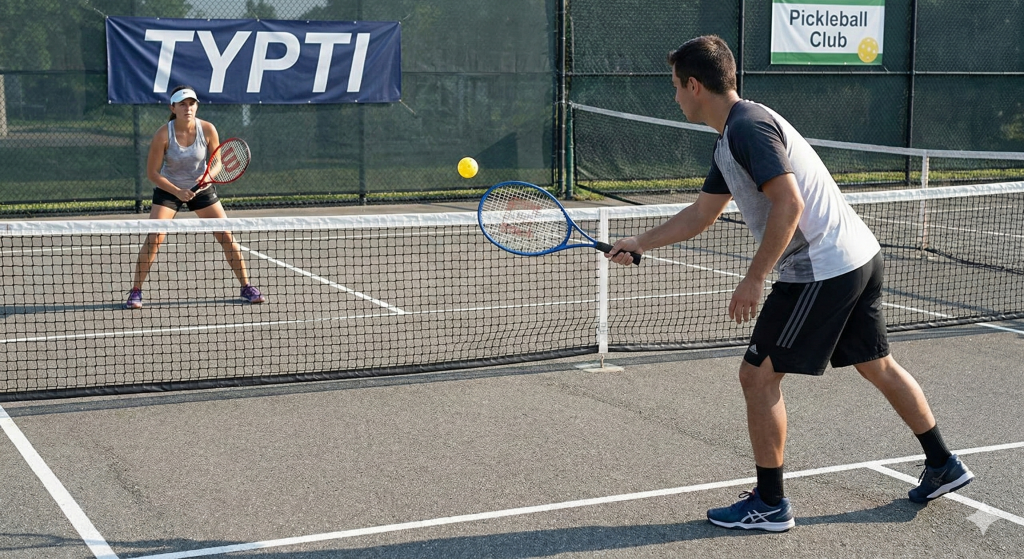
Let’s talk about something that just launched this week and has the entire racket sports community buzzing—a new sport called Typti.
Yes, you read that right. In a world where we already have tennis, pickleball, padel, platform tennis, racquetball, squash, and badminton, someone decided we needed one more racket sport. And that someone is Tennis Channel founder Steve Bellamy, backed by an 80-person investor group including Drew Brees, Nick Kyrgios, Tony Robbins, Chris Pine, JJ Abrams, Tiffany Haddish, and comedian Bert Kreischer.
The pitch? Typti is a cross between tennis and pickleball, played on a pickleball court with foam balls and small tennis-like rackets. Think mini-tennis meets trick-shot YouTube video. Let me break down what we know, why I’m skeptical, and why I’m also kind of excited about it.
The Gist: Typti is a new “hybrid” racket sport backed by Tennis Channel founder Steve Bellamy and Drew Brees that attempts to merge tennis mechanics with pickleball infrastructure.
The Gear: Played on a standard pickleball court using 22-inch strung rackets and a channeled foam ball (heavier than a wiffle ball, lighter than a tennis ball).

New: Pickle Rock Radio
I just launched a brand new 24/7 internet broadcast... a free Pickleball Radio Station that soundtracks your open play sessions with 90s & 00s alternative rock, while dropping pro tips, local court reports, and gear news between tracks.
Please tune in and share your honest feedback!
Listen to the Live Broadcast →The Twist: The rules are distinct and controversial. They include “chess-like” scoring transfers and, most notably, the ability to use body parts (feet, hands, etc.) to keep the ball in play if it bounces off the net.
The Verdict: While it cleverly utilizes existing pickleball courts and aims to capture former tennis players, critics warn that the “trick-shot” nature and body-save rules could lead to a higher risk of injury on hard courts.
*Note: Both sports share the exact same 20′ x 44′ court dimensions.
What Exactly Is Typti?
Typti (which Bellamy says is a five-letter meaningless word—following the Kodak branding philosophy—starting with “t” as homage to tennis) is played on a standard pickleball court using 22-inch strung rackets and a 3.5-inch diameter channeled foam ball that’s heavier than a wiffle ball but lighter than a tennis ball.
The scoring system is unique: you need three points to win a game, but here’s the twist—if you’re up 2-0 and lose game point, the right to game point transfers to your opponent even if they had zero points. You need five games to win a set. It’s chess-like strategic, supposedly.
But here’s where it gets really interesting (or gimmicky, depending on your perspective): players can play the ball off the net, and on the bounce, you can use anything except the racket strings to get a second chance to hit it over. That means racket handle, feet, hands—all legal. The foam ball bounces high enough after hitting the net that you have time to attempt these “wacky” saves, as the promotional materials call them.
According to Bellamy, it’s “incredibly easy for beginners” with “great rallies in minutes,” yet “chess-like for the pros.” They’re already planning professional tournaments with at least $500,000 in prize money in year one, scaling to million-dollar events. Drew Brees—who apparently beat Andy Roddick three times as a 12-year-old junior tennis player—is informally one of the top 10 Typti players in the world, having spent two years helping develop the rules.
Need a break from the court?
I wrote a short story called "Dropkicks and Dinks" about a pro-wrestler finding solace in pickleball. It's featured in my new collection.
Get it on Amazon →My Skepticism: The Bro Sport Problem
Let’s be honest about what this looks like from the outside: a bunch of celebrity investors and former athletes creating a sport that emphasizes trick shots, body saves, and “wild rallies.” The promotional language talks about doing “things with a ball that other racket sports just can’t.” There’s already over $100,000 in prize money and talk of “the Wimbledon of Typti.”
This has serious “bro culture” written all over it. It feels designed for Instagram highlights and YouTube compilations—the racket sport equivalent of slam ball or three-on-three basketball tournaments with music blaring and announcers hyping every play. The investor list reads like a “guys’ weekend at Necker Island” guest roster (which is literally where Bellamy and Brees met and started developing this).
And here’s my bigger concern: injury potential. The foam ball might be lighter than a tennis ball, but you’re still using tennis-like rackets on a small court with rules that encourage diving saves and using your body to play the ball. Pickleball already has injury rates that have increased ninefold in the past decade, with 91% of those injuries occurring in players 50 and older. The most common injuries are sprains, strains, fractures, and Achilles problems.
Now we’re adding a sport that explicitly encourages players to use their feet and hands to save balls off the net? On a hard court surface? With heavier equipment than pickleball paddles? I can already see the orthopedic surgeons preparing their calendars.
The smaller court size doesn’t automatically mean safer—pickleball research has shown no correlation between court size and injury rate. What causes injuries is quick lateral movements, sudden stops, overhead motions, and the repetitive stress on joints. Typti appears to have all of those, plus the added risk of players attempting acrobatic saves because the rules explicitly allow it.
Why I’m Also Cautiously Optimistic
But here’s the thing—and I’m going to be honest because this is what Ace’s column is about—any sport that gets people off the couch and onto a court is fundamentally a good thing.
Bellamy’s investment thesis is actually pretty smart: 130 pickleball venues are opening every month in the United States, and Typti uses the same courts. The infrastructure is already there. He estimates there are 25 million former tennis players who won’t play pickleball but might play something that utilizes more tennis skills. If Typti can capture even a fraction of that market, it could carve out a legitimate niche.
And let’s be real—pickleball started as a backyard game invented by bored dads on Bainbridge Island trying to entertain their kids. Now it’s a multi-billion dollar industry with professional leagues, major sponsors, and millions of players. Who’s to say Typti can’t follow a similar path?
The social aspect of racket sports is genuinely valuable. Studies show that pickleball and tennis improve cardiovascular health, mental well-being, agility, balance, and coordination. They foster community, sportsmanship, and social connections. If Typti accomplishes any of that—even with gimmicky rules and celebrity investors—it’s still getting people active and creating camaraderie.
Drew Brees makes a fair point when he says this “opens up a realm of opportunity for pickleball facilities” by offering another sport option. Variety keeps things interesting. If someone gets bored with pickleball or wants something different, having Typti available at the same venue could keep them engaged with racket sports generally.
My Honest Take: Prove It
Look, I’m a 4.5 pickleball player who loves this sport and wants to see racket sports thrive. Do I think Typti is a genius innovation that will revolutionize athletics? No. Do I think the rules encouraging trick shots and body saves feel designed more for viral videos than sustainable competition? Yes.
Do I think there’s a real injury risk when you combine tennis rackets, foam balls, small courts, and rules that encourage players to use their feet and hands? Absolutely. We’ve seen how pickleball injuries have skyrocketed as the sport has grown, particularly among older players. Typti needs to be very thoughtful about promoting proper warm-ups, appropriate footwear, and realistic expectations about what your 55-year-old body should be attempting.
But do I also think that if Typti gets even a few thousand people who weren’t playing any racket sport to pick up a racket and start moving? That’s a win. If it creates community, fosters competition, and gives people something to look forward to after work? That’s valuable.
My advice to the Typti organization: Don’t lean so hard into the trick-shot, bro-culture marketing. Emphasize the accessibility, the community, the fitness benefits. Partner with sports medicine professionals early to develop injury prevention protocols. Make sure the professional circuit doesn’t become all spectacle and no substance. And please, for the love of all that is holy, make sure people are wearing proper court shoes and warming up before attempting foot saves.
My advice to pickleball facilities considering adding Typti: Give it a shot. See if your members are interested. But don’t rip out your pickleball courts to install dedicated Typti courts anytime soon—let this prove itself first.
And my advice to players: If you try Typti and it gets you moving, great. If you stick with pickleball, great. If you rediscover tennis, great. The point is to find what keeps you active, engaged, and enjoying life. Competition between racket sports benefits all of us by keeping innovation alive and facilities invested in maintaining quality courts.
Just maybe don’t lead with the foot saves until you’ve had a proper warm-up.
— Ace
What is Typti? Typti is a new racket sport launched in early 2026 that combines elements of tennis and pickleball. It is played on a standard pickleball court but uses smaller strung tennis rackets and a specific high-density foam ball. The sport is backed by a high-profile investor group including Steve Bellamy, Drew Brees, and Nick Kyrgios.
How is Typti different from pickleball? While Typti uses the same court dimensions as pickleball, the equipment and gameplay mechanics are closer to tennis. Players use 22-inch strung rackets (not solid paddles) and a foam ball that allows for more spin and bounce than a plastic pickleball. Additionally, Typti allows for “wild” saves using body parts, whereas pickleball has strict rules against touching the ball with anything but the paddle.
What are the scoring rules in Typti? Typti uses a unique scoring system where a player needs three points to win a game, and five games to win a set. A key strategic twist is the “point transfer” rule: if a player is leading 2-0 and loses the next point, the “game point” opportunity transfers to their opponent, even if that opponent has zero points.
Can you use your feet or hands in Typti? Yes. One of the most controversial rules in Typti is that players are allowed to use any part of their body (feet, hands, etc.) or the racket handle to keep the ball in play, provided it is not the racket strings, specifically to make saves on balls that bounce off the net.
Is Typti dangerous? There are concerns regarding the safety of Typti. Critics argue that rules encouraging diving saves and the use of feet on a hard court surface may increase the risk of injury. The combination of quick lateral movements common in racket sports with “acrobatic” saves could potentially lead to more sprains, strains, and fractures compared to standard tennis or pickleball.
Who created Typti? Typti was founded by Steve Bellamy, the founder of the Tennis Channel. It was developed over two years with input from former NFL quarterback and tennis enthusiast Drew Brees, who serves as one of the sport’s primary ambassadors.

What about creating a hybrid sport that reduces the injury potential? Use the
Typhi racket and ball with pickleball rules. It would help with noise issues and provide a stimulating game.
Sounds logical. I need to give that a try!