
Last Updated on December 29, 2025 by Drew Pierce
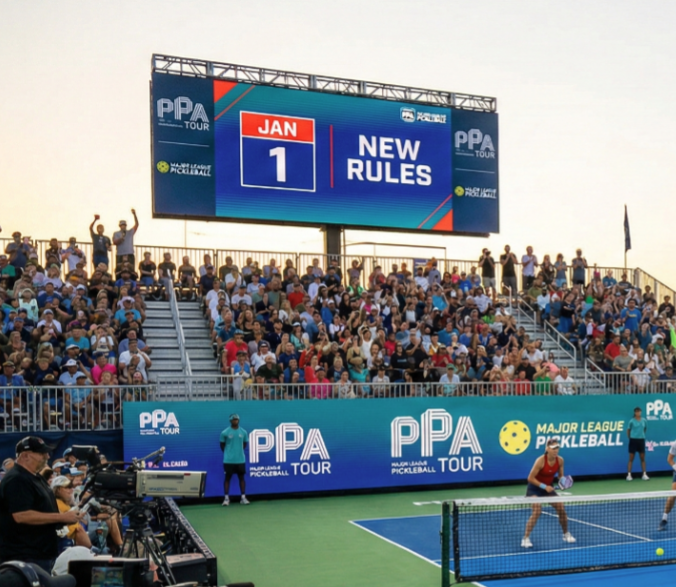
Happy holidays, pickleballers! Ace here, coming at you between Christmas and New Year’s with some major developments that are shaping what 2026 is going to look like for professional pickleball. While most of us are enjoying time off, eating too many cookies, and getting court time in when we can, the business side of pro pickleball just went through a seismic shift that’s going to impact how the sport operates for years to come. Let’s break it down.
UPA Restructures Contracts: The Guaranteed Money Era Ends
This is huge, and if you’re not paying attention to the business side of pro pickleball, you should be—because it affects everything from how tournaments are structured to how players approach competition.
The United Pickleball Association announced a major restructuring of player contracts that fundamentally changes how pros get paid. Starting in 2026, the league is moving away from guaranteed salaries and toward a performance-based prize money model. Here’s how it works:
Players with contracts running through 2026 will have their final year’s guarantee split into thirds and spread across 2026-2028. So if you were guaranteed $150,000 for 2026, you’ll now get $50,000 per year for three years instead. That’s a 66% cut in annual guaranteed income.
But—and this is the critical part—the UPA is adding massive prize pools to compensate. We’re talking $15 million in domestic prize money, plus $5 million internationally, on top of the $11 million in guaranteed salaries. Total player earnings potential: $31 million starting in 2026.
This is modeled after tennis and golf, where prize money rewards performance rather than guarantees paying everyone regardless of results. The logic makes sense: if you want to be a professional athlete, you should have to compete and win to earn a living. It incentivizes excellence, eliminates players coasting on guarantees, and makes every tournament matter.
There are three contract tiers. Gold Contract holders (players who signed during the 2023 “Tour Wars”) get access to the highest prize pools—up to $45,000 for winning a Slam in gender doubles. Standard Contract holders (who signed in 2024 or later) get access to smaller prize pools—around $12,000 for winning the same event. And Futures Contract players get even less—roughly $6,000 for a Slam win.
The deadlines were aggressive. Gold Card players had until August 15, 2025 to sign. Standard Contract players had until September 23rd. Players who didn’t sign by November 1st get locked into the Futures grid with a six-month minimum contract.
Here’s my take: this was inevitable and necessary. The Tour Wars created an unsustainable financial situation where players were getting six-figure guarantees regardless of performance. That works when you’re trying to sign talent away from a competitor, but it doesn’t work long-term when you’re trying to build a viable professional sports league.
Will some players get hurt by this? Absolutely. Mid-tier pros who were making decent guaranteed money might struggle if they can’t consistently finish in the top 8 of tournaments. But top players—the ones driving viewership and ticket sales—will make more than ever before. And that’s how it should work in professional sports.
2026 Rules Are Here: What Actually Changed
USA Pickleball released the 2026 Official Rulebook, effective January 1st, and the internet went into its annual frenzy of “OMG THEY CHANGED EVERYTHING.” Except… they didn’t. Not really.
The biggest change isn’t about gameplay—it’s about organization. USAP completely restructured the rulebook into four logical sections. Part I covers basics (the game, definitions, equipment). Part II is what 95% of recreational players actually need (scoring, serving, faults). Part III is tournament-specific rules. Part IV is adaptive/wheelchair play.
This is genuinely helpful. The old rulebook was a mess—tournament rules mixed with rec play, wheelchair adaptations scattered everywhere. Now if you’re playing Sunday morning open play, you can ignore Parts III and IV completely.
As for actual rule changes, there are a few worth knowing:
Volley serve clarification: The serve requirements haven’t changed—contact below the waist, paddle head below wrist, upward arc. But they added the word “clearly” to the language, meaning if it’s not obviously legal, it can be called a fault. This matters in tournament play where refs will crack down on borderline serves.
Spin serve confusion eliminated: You CAN spin the ball on contact with your paddle. You CANNOT manipulate the ball with your hand before contact. The 2026 rulebook just makes this clearer because people kept misinterpreting it.
Technical fouls clarified: Penalties can now be assessed during pre-match briefings and warmups, not just during matches. And the language around physical violence and venue damage is more explicit—probably a response to some viral incidents in 2025 where things got out of hand.
Rally scoring formalized: For tournaments that use it, the 2026 rulebook officially outlines approved rally-scoring formats. This remains optional for most events but gives structure to how it can be implemented.
Adaptive play recognition: There’s now a formal adaptive standing division with clear rules for players who compete standing but have permanent physical disabilities affecting mobility, balance, or coordination.
Bottom line: if you’re a recreational player, you’re not changing anything about your game on January 1st. Your serve is fine. The kitchen rules are the same. Double-bounce rule hasn’t changed. You can relax.
What 2025 Taught Us About Pickleball’s Growth
As we close out the year, it’s worth stepping back to appreciate how far pickleball has come in 2025—and what it tells us about where we’re headed.
The Indian Pickleball League launched successfully, proving that franchise-based professional pickleball works internationally. The Global Pickleball Alliance united seven organizations across multiple continents, creating the first coordinated global tour. We got a primetime holiday movie on Lifetime (even if the actors couldn’t actually play pickleball). Major League Pickleball announced automatic line calling for 2026, bringing tennis-level technology to our sport.
On the court, we saw continued dominance from Anna Leigh Waters and Ben Johns, but also breakthrough performances from younger players. Christopher Haworth went from ranked 57th to top-five in men’s singles. Roscoe Bellamy won his first PPA gold. The sport keeps developing new talent, which is critical for long-term viability.
The UPA contract restructuring tells us something important: professional pickleball is maturing. The Wild West era of throwing money at players to secure exclusivity is over. We’re moving toward a sustainable business model where performance drives compensation. That’s painful in the short term for some players, but it’s essential for building a sport that can support professional careers for decades, not just a few years.
And the fact that USA Pickleball reorganized the rulebook to separate recreational from tournament play shows they understand their audience. Most people playing pickleball aren’t competing in sanctioned tournaments—they’re playing for fun, exercise, and community. Making the rules accessible to that majority is smart.
Looking Ahead: 2026 Will Be the Most Important Year Yet
Here’s my prediction: 2026 will determine whether pickleball becomes a truly global, financially sustainable professional sport or whether it plateaus as a popular recreational activity with a small pro circuit.
The Global Pickleball Alliance launches its full calendar. The UPA’s prize money model either proves viable or fails spectacularly. MLP’s automatic line calling either becomes the standard or reveals implementation issues. International competition intensifies as more countries invest in the sport.
For those of us who love this game, the stakes have never been higher—or more exciting.
Enjoy the rest of the holidays, hit the courts when you can, and I’ll see you in 2026 for what promises to be the most pivotal year in pickleball history.
—Ace
Here’s to 2026. Let’s make it count.
