
Last Updated on March 5, 2026 by Drew Pierce
Hey pickleball fans, Ace here. While everyone’s been obsessing over the MLP draft drama (and rightfully so—$1.23M for Anna Bright is insane), some other significant developments have been unfolding in the professional pickleball world. The APP Tour is making moves, former pros are pivoting to business, and we’ve got some actual data on injuries that might make you rethink your gear choices.
Let’s dig into what happened this week beyond the MLP circus.
APP Tour Stacks Its Roster: The Talent War Continues
The Association of Pickleball Professionals (APP) Tour just announced a series of new professional player signings for the 2026 season, and it’s clear they’re trying to position themselves as a legitimate alternative to the PPA Tour.
The headliner? Jack Munro, who’s been making noise on the circuit and recently shared insights on what it takes to become a top-level player. But Munro isn’t alone—the APP is bringing in multiple new pros as they build out their roster for what’s shaping up to be an increasingly competitive year.
Here’s what’s interesting: The APP Tour has always played second fiddle to the PPA in terms of prestige and prize money. But with the PPA focused on its partnership with MLP and the restrictive contracts that come with UPA affiliation, the APP is positioning itself as the more accessible option for pros who want flexibility.
Think about it: If you’re a rising star who doesn’t want to commit to the UPA’s exclusive contract requirements, the APP Tour offers a pathway to professional competition without locking yourself into the PPA/MLP ecosystem. That’s not a small advantage.
The implications are clear: we’re heading toward a talent war between tours. The PPA has the biggest names and the most money. The APP has flexibility and growing prize pools. Players are going to have to choose sides, and that choice will shape the future of professional pickleball.
Quang Duong Signs Multi-Year APP Deal: A Post-UPA Comeback
Speaking of players choosing sides, Quang Duong just inked a multi-year deal with the APP Tour, marking his return to U.S. competitions less than a year after his UPA contract was terminated.
For those who don’t remember: Duong was one of several players (along with James Ignatowich, Ryan Fu, and Vivian Glozman) who had their UPA contracts terminated in late 2025 for participating in unsanctioned Pickleball Japan Federation events. The UPA claimed these were competitor events that violated exclusive contracts. The players filed appeals arguing they didn’t receive compensation and weren’t promoting a rival tour.
Now Duong is back, but not with the PPA/UPA. He’s with the APP, which doesn’t have the same exclusive restrictions. This is smart positioning by the APP—they’re scooping up talent that the UPA cast aside, giving these players a professional home while simultaneously strengthening their own tour.
Duong is a legitimate talent. He’s shown he can compete at the highest levels. Having him locked into a multi-year APP deal gives them stability and a marketable name. It also sends a message to other pros: if the UPA burns you, the APP will take you in.
This is how competitor leagues grow. You can’t outspend the market leader, so you focus on acquiring undervalued talent and providing opportunities to players who’ve been shut out of the dominant system. The APP is executing that playbook perfectly.
MLP Trade Window #2 Opens: More Chaos Incoming
As if the draft wasn’t enough drama, MLP’s second trade window opened this week and will run through July, giving teams months to tinker with their rosters before the May 22nd season opener.
No major trades have been announced yet, but the framework is in place. Teams that struck out on their draft targets can make moves. Teams that overdrafted teenagers and need veteran stability can trade for experience. Teams that overspent and need to dump salary can make cash-for-player swaps.
Here’s what I’m watching for:
Dallas making a move for a top women’s player. They lost Jorja Johnson and need to replace that production somehow. Do they try to trade for Lea Jansen? Do they go after one of the veterans who went cheap in the draft?
Phoenix trading some of their teenagers for immediate help. They went full youth movement, which means they’re probably going to be terrible in 2026. But if ownership decides they want to be competitive now instead of in 3 years, they’ve got tradeable assets.
Columbus doing… something. They’re defending champs who dropped Lea Jansen and didn’t land Anna Bright or Jorja Johnson in the draft. What’s their plan? Do they run it back with Parris Todd and Andrei Daescu and hope it’s enough?
MLP is keeping trade updates live on social channels, which is smart fan engagement. Nothing builds buzz like real-time roster drama. Expect the next few months to feature constant speculation and surprise moves.
James Ignatowich’s Post-Termination Empire: RPM Paddles Explodes
Here’s the most fascinating story of the week James Ignatowich is selling 10,000 RPM paddles per month and is relocating to China to expand operations.
Let that sink in. Less than a year after having his UPA contract terminated, Ignatowich has built a paddle company that’s moving five figures in monthly unit sales. That’s not a side hustle. That’s a legitimate business.
Ignatowich discussed the situation openly: his UPA termination essentially banned him from PPA Tour events (since the PPA requires UPA affiliation). So instead of fighting it, he pivoted. He launched RPM paddles, focused on manufacturing quality and player feedback, and built a brand that’s resonating with consumers.
Now he’s planning to compete in non-PPA tournaments (presumably APP and international events) while running his paddle business from China, where manufacturing costs are lower and he can oversee production quality directly.
This is entrepreneurship 101: when one door closes, find a window, kick it open, and build a business empire. Ignatowich took what could have been a career-ending setback and turned it into a launching pad for financial independence.
The implications are huge. If Ignatowich can build a successful paddle company in under a year while banned from the biggest tour, what does that say about the barriers to entry in the pickleball equipment market? It suggests there’s massive demand, relatively low manufacturing complexity, and room for new brands to challenge the established players like JOOLA, Selkirk, and Franklin.
It also highlights the tension in professional pickleball right now. The UPA wants exclusivity. The PPA Tour requires UPA affiliation. But players like Ignatowich are showing that there are viable paths outside that ecosystem—you can make good money selling paddles and competing on alternative tours without needing the PPA’s blessing.
Pickleball in Prison: Maine’s Unlikely Success Story
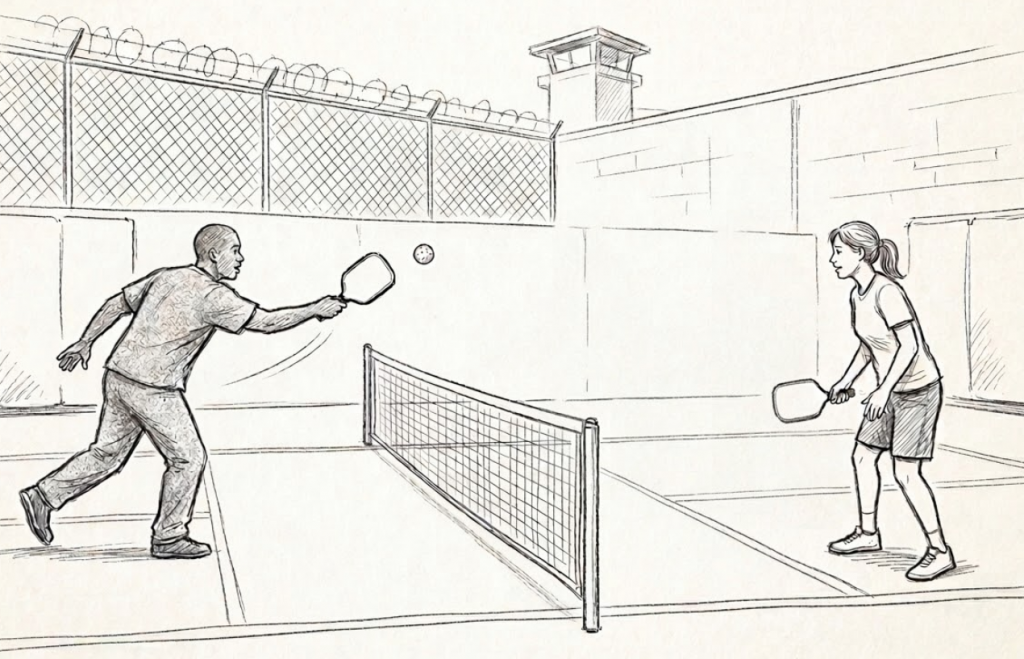
Here’s a feel-good story that deserves more attention: Maine State Prison has been running a pickleball program for nearly a year, bringing volunteers from local clubs to play with inmates and guards.
The program was started by the former warden and has been remarkably successful. Volunteers from midcoast pickleball clubs come in regularly to play, creating social connections and providing recreation in an environment where both are scarce.
Why does this matter? Because it shows pickleball’s accessibility and community-building power. This isn’t a sport that requires expensive equipment, large facilities, or years of training. You can set up courts in a prison gym, teach the basics in an afternoon, and create meaningful social interaction between people who would never otherwise meet.
The rehabilitation and mental health benefits are real. Physical activity reduces recidivism. Social connection with people from outside the prison system helps inmates maintain ties to the community they’ll eventually rejoin. And for the volunteers, it’s a way to give back while doing something they love.
This is the kind of story that reminds you why pickleball’s growth is about more than just professional tours and million-dollar contracts. At its core, this sport brings people together. Even in a maximum-security prison.
Whitefish Bay Noise Ordinance: The Eternal Pickleball Battle
In less uplifting news, Whitefish Bay just passed an ordinance regulating pickleball court hours, reigniting the age-old battle between enthusiastic players and noise-concerned residents.
The ordinance restricts play times on courts along N. Shore Drive, attempting to balance community access with neighborhood peace. Players are mad because it limits when they can use public courts. Residents are relieved because the constant pop-pop-pop of pickleball at 7am on a Saturday was driving them insane.
I’ve written about this before, but it bears repeating: pickleball noise is a real problem that the sport needs to address systemically. Acoustic barriers, quieter balls, noise-dampening court surfaces—these are solvable engineering problems. But until the industry invests in solutions, we’re going to keep seeing these local conflicts.
The Whitefish Bay situation could set a precedent for pickleball regulations in residential areas nationwide. If their ordinance holds up and reduces complaints without killing participation, other municipalities will copy it. If it backfires and creates more conflict, cities will look for different approaches.
Either way, this is a growing pain that comes with rapid expansion. When you go from niche sport to mainstream activity in five years, you inevitably clash with communities that weren’t ready for the noise and traffic that comes with public courts.
Eye Protection: The Safety Gear Nobody Wants to Wear
Here’s some data that should concern everyone: new research shows alarmingly low adoption of protective eyewear among pickleball players, and eye injuries are on the rise.
This shouldn’t be surprising. Pickleball involves hard plastic balls traveling at high speeds from close range. The kitchen is seven feet from the net. People stand directly across from each other hitting volleys. Getting hit in the face is not a matter of “if” but “when.”
Yet almost nobody wears protective eyewear. Why? Because it looks dorky. Because it fogs up. Because “I’ve been playing for two years and never had a problem.” Because we’re all subject to optimism bias and assume bad things happen to other people.
The researchers are calling for better education and potentially mandatory gear requirements for sanctioned play. I’m skeptical about mandates—people hate being told what to do—but education could work if positioned correctly.
Here’s my pitch: “Hey, you know what’s dorky? A detached retina. You know what’s inconvenient? Being blind in one eye for the rest of your life. For $30 you can get sports glasses that prevent both of those outcomes.”
The professional tours should lead on this. If PPA and APP pros started wearing protective eyewear, recreational players would follow. It wouldn’t even require rule changes—just have a few high-profile pros start wearing them and talk about why safety matters.
Of course, that would require paddle sponsors to also make eyewear, or for players to add another sponsorship deal, so the financial incentives aren’t quite aligned yet. But it’s coming. The injury data is too clear to ignore forever.
What It All Means: A Sport in Transition
Let me tie all of this together.
The APP Tour is building a competitive alternative to the PPA. Players who’ve been burned by the UPA are finding homes on alternative tours. MLP is continuing its roster chaos through open trade windows. Former pros are building paddle companies. Prisons are running pickleball programs. Municipalities are regulating court hours. And everyone should probably be wearing eye protection but nobody is.
These aren’t disconnected stories. They’re all symptoms of the same phenomenon: pickleball is growing so fast that the infrastructure, governance, and culture are struggling to keep up.
Professional tours are competing for talent and market share. Equipment markets are opening up to new entrants. Communities are figuring out how to accommodate explosive participation. Safety protocols are lagging behind injury rates.
This is what it looks like when a sport transitions from “fun backyard activity” to “legitimate mainstream sport with professional leagues, million-dollar contracts, and serious business implications.”
It’s messy. It’s chaotic. There will be casualties—both literal (eye injuries) and figurative (players left behind by the youth movement, businesses that can’t compete).
But it’s also exciting. We’re watching a sport figure out what it wants to be in real time. And unlike established sports where the power structures are calcified, pickleball is still fluid enough that entrepreneurs like Ignatowich can build empires and alternative tours like the APP can challenge the establishment.
The next few years will determine whether professional pickleball consolidates under one dominant structure or fractures into competing ecosystems. Whether safety becomes mandatory or remains optional. Whether noise disputes kill growth in residential areas or get solved through engineering.
I don’t know how it all plays out. But I know it’s going to be fascinating to watch.
