
Last Updated on October 27, 2026 by Drew Pierce
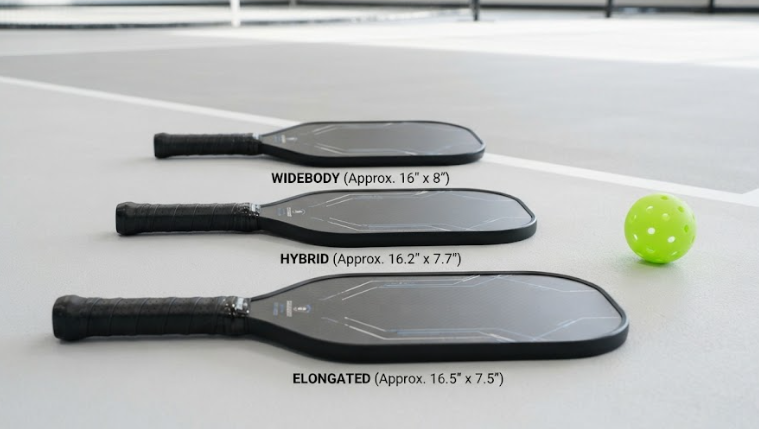
Widebody paddles (about 16″ x 8″) have the biggest sweet spot and the quickest hands at the kitchen. Elongated paddles (about 16.5″ x 7.5″) give up some of that forgiveness for reach, leverage and spin. Hybrids land in the middle. If you’re not sure which you need, start with a hybrid or a widebody. Most players are better off there than with a long paddle, and that includes us tennis converts.
Quick Answers
- Widebody: largest and most forgiving sweet spot, quickest at the net, least reach. Good for beginners and doubles players who live at the kitchen.
- Elongated: most reach and leverage on drives, serves and spin, but the least room for off-center hits. Good for singles, big drivers and players with clean contact.
- Hybrid: a bit more reach than a widebody, a bit more forgiveness than an elongated. The safe pick if you mostly play doubles and can’t decide.
- The rule behind all of it: USA Pickleball caps paddle length at 17 inches and length plus width at 24 inches. A longer paddle is always a narrower paddle.
Why Do Pickleball Paddles Come in Different Shapes?
It all comes down to one rule.
Under the 2026 USA Pickleball Official Rulebook, Rule 3.D.2 says length plus width, including the edge guard and butt cap, can’t go over 24 inches. Length alone can’t go over 17 inches. There’s no limit on thickness or weight. (Older guides cite 2.E.3. That’s where the same rule lived in the 2025 book.)
So every paddle company is working with the same 24-inch budget. If a paddle is already at the limit, every half inch of length it gains costs half an inch of width.
That’s why the numbers bunch up so tightly. Selkirk’s shape guide lists its widebody at 15.95″ x 8.0″ and its elongated at 16.5″ x 7.45″. Pickleball Warehouse’s shape explainer calls 16.5″ x 7.5″ the classic elongated and 16″ x 8″ the classic widebody, with hybrids around 16 to 16.3 inches long.
One quick gut check while we’re here. I’ve seen guides say elongated paddles run 17 to 19 inches. They don’t. The rulebook stops at 17, and most elongated paddles sit right around 16.5. If a guide gets that wrong, I wouldn’t trust the rest of it either.
What’s the Difference Between Elongated, Widebody and Hybrid Paddles?
Here’s how the three shapes compare. Fair warning: these are general patterns from manufacturer and retailer specs, not lab results from my garage, and any one paddle can break the pattern.
| Widebody | Hybrid | Elongated | |
|---|---|---|---|
| Typical size | About 15.75–16″ x 8″ | About 16–16.3″ x 7.6–7.9″ | About 16.5″ x 7.4–7.5″ |
| Sweet spot | Largest, closer to your hand | Medium | Smallest, higher on the face |
| Hand speed at the kitchen | Fastest | Quick | Slowest of the three |
| Reach | Least | Some extra | Most |
| Best for | Beginners, doubles players who live at the kitchen | Most rec doubles players, people who play both formats | Singles, big drivers, players with consistent contact |
| Arm and back considerations | Off-center hits tend to twist less, which some players find easier on the forearm | A middle ground on both counts | Mass sits farther from your hand, so it can feel heavier to swing over a long session |
That bottom row is the one I wish someone had shown me sooner.
I’m not a doctor, and I’m not going to tell you a paddle shape will fix your elbow. But I’ve got a cranky lower back and an SI joint that keeps score. What I’ve learned is that how a paddle feels in hour two matters a lot more than how it feels on swing one in the store. If your body has opinions too, read my guide on the best pickleball paddle for tennis elbow and my post on pickleball and lower back pain before you go long.
Are Elongated Paddles Better for Tennis Players?
Not automatically. This is the one I most want to talk people out of.
Retailers love to say elongated paddles are “great for tennis players.” I understand why. The length feels familiar, the longer handle leaves room for a two-handed backhand, and the extra leverage gives you the pop you’re used to on groundstrokes. I bought into it completely.
What tennis didn’t prepare me for was the kitchen.
In rec doubles, a lot of points get decided in quick exchanges from a few feet apart. That’s exactly where a long paddle is slowest. Your tennis brain says take a swing. Pickleball says get the paddle up first and worry about the swing later.
If you’re a tennis convert who mostly plays doubles, demo a hybrid before you buy an elongated. If you play a lot of singles, or you’re a driver by nature, elongated makes more sense. I go deeper on grip length and weight in how to pick pickleball paddles for tennis players.
Which Paddle Shape Is Best for Beginners?
Widebody or hybrid. I don’t think this one’s close.
When you’re new, you’re going to hit the ball off center. Constantly. A wider face gives you more room to miss and still keep the ball in play.
Pickleball Science, which actually measures this stuff in a lab, concluded that wider paddles are generally more forgiving than elongated ones for beginner and intermediate players. They have more hitting area side to side, and they twist less when you catch the ball off center. Their suggestion is to think about an elongated paddle once you can reliably find the middle.
That matches what I see on court every week. Newer players almost never lose a point because they couldn’t reach a ball. They lose it on a mishit.
Swing Weight vs Twist Weight: Why Shape Is Only Half the Story
Static weight is the number on the scale. It tells you less than you’d think.
Swing weight is how heavy the paddle feels when you’re actually swinging it. It depends on where the mass sits, not just how much there is. More mass out toward the tip means a higher swing weight. You usually get more plow-through and power, and you give up some hand speed.
Twist weight is how much the paddle resists turning in your hand on an off-center hit. Higher twist weight means a steadier, more forgiving face. Width is the biggest driver here, which is why widebodies tend to score higher.
The general pattern:
- Elongated paddles tend to have higher swing weight and lower twist weight.
- Widebody paddles tend to have lower swing weight and higher twist weight.
- Hybrids fall in between.
That “tend to” matters, though. Manufacturers can move weight around inside any shape, so two elongated paddles can swing nothing alike. Pick the shape for the forgiveness you need, then look up that specific paddle’s published swing weight before you buy.
You can also tweak things yourself. A little lead tape on the edges can add stability, and I explain where to put it in how to use lead tape for pickleball paddles. Weighted tape is a legal alteration under Rule 3.D.6, but it changes how the paddle swings, so go light and add a little at a time.
How Do I Actually Choose?
Answer three questions, and be honest with yourself.
1. Where do you win and lose points? If it’s at the kitchen, go widebody or hybrid. If it’s on drives, serves and passing shots, an elongated paddle earns its spot in your bag.
2. How clean is your contact? If you’re still framing balls or catching the edge guard, take the bigger sweet spot. Nobody at your courts is checking your paddle shape for street cred.
3. What does your body say after two hours? If your forearm, shoulder or back start complaining late in a session, look hard at how heavy the paddle swings, whatever shape it is.
Then demo before you buy. Shape is the one thing you really can’t judge from a product page. My 7-day paddle demo guide walks you through it.
FAQ
What are the dimensions of an elongated pickleball paddle?
Most elongated paddles are about 16.5 inches long and 7.4 to 7.5 inches wide. Selkirk lists its elongated shape at 16.5″ x 7.45″, and Pickleball Warehouse calls 16.5″ x 7.5″ the classic elongated size.
What is the maximum legal pickleball paddle size?
Under Rule 3.D.2 of the 2026 USA Pickleball rulebook, a paddle can be no longer than 17 inches, and length plus width, including the edge guard and butt cap, can’t exceed 24 inches. There’s no limit on thickness or weight.
Is a hybrid paddle good for beginners?
Yes. A hybrid keeps most of a widebody’s forgiveness and adds a little reach. If mishits are your biggest problem, a widebody is the more forgiving choice.
Do elongated paddles give you more power?
Generally, yes, on full swings. The extra leverage can mean more power and spin on drives and serves. The tradeoff is a smaller sweet spot and slower hands at the net.
Do pros use widebody paddles?
Some do. Retailers report that elongated is the most common shape on the PPA Tour, but plenty of top doubles players use standard or widebody shapes for hand speed at the kitchen.
Does paddle shape matter more than weight?
They work together. Shape mostly drives forgiveness (twist weight). Where the weight sits drives how heavy the paddle feels to swing (swing weight). Pick the shape first, then check the swing weight.

Drew Pierce is a USA Pickleball Ambassador, PPR certified coach, and tennis crossover who covers beginner tips, paddle releases, and the sport’s growing culture. Read more on his About page or tune into Pickle Rock Radio.