
Last Updated on March 1, 2026 by Drew Pierce
Australian Doubles (often called “Cutthroat”) is a 3-player pickleball format where one person plays solo against a team of two. The solo player serves and is the only one who can score points. Players rotate clockwise after every rally, ensuring everyone plays both solo and team positions.
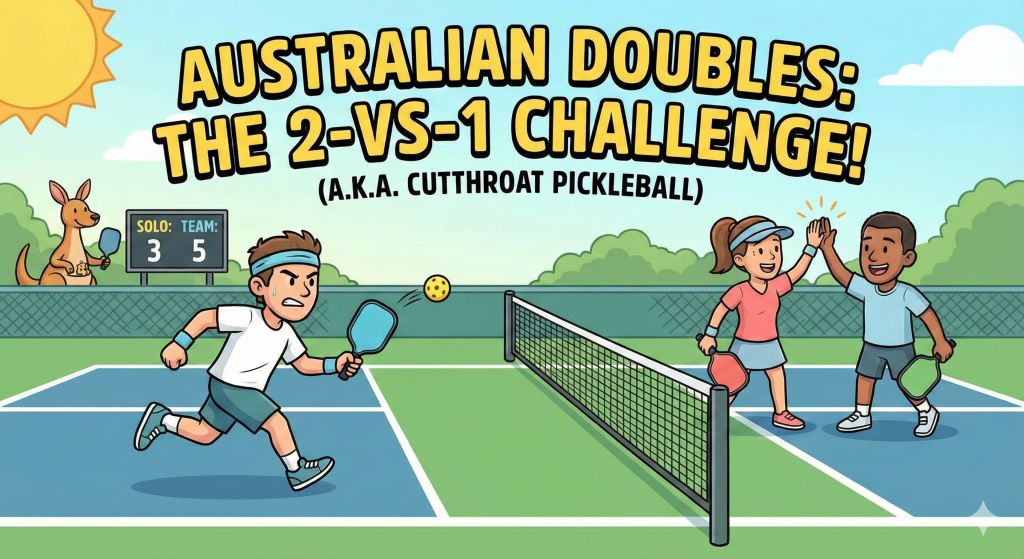
Australian Doubles is a fast-paced pickleball variation played with three people on a standard-sized court. Also known as “Cutthroat” (don’t worry, it’s not as violent as it sounds), this game format solves the eternal problem of having an odd number of players show up at the court. Here’s how it works: the court is divided lengthwise down the middle, with one player serving solo from one side while a team of two players covers the opposite half. Players rotate positions after each point, which means you’re constantly switching between being the lone wolf and being part of a team. The beauty of Australian Doubles? It keeps everyone engaged and active—no one sits out waiting for their turn. Plus, it tests your skills in ways that regular doubles simply can’t.
How to Set Up Australian Doubles
Court Setup
Setting up for Australian Doubles is simple:
- Split the court lengthwise: Imagine a line running down the center of the court from baseline to baseline, dividing it into two equal halves
- One player takes one side: This is your solo player who will serve first
- Two players take the other side: These players work as a team, just like in regular doubles
The division isn’t marked on the court—it’s just understood. The solo player has to cover their entire half of the court, while the team of two splits their half like they would in regular doubles.
Starting Positions
The solo player serves from behind the baseline on their side (following normal serving rules). The two-player team positions themselves just like in doubles—one at the baseline to receive, one at the kitchen line or ready to move up.
Australian Doubles Rules and Scoring
Serving Rules
The serving rules are where Australian Doubles gets interesting:
- The solo player gets TWO faults before a side-out: This is critical. Because the solo player is at a disadvantage covering the full court alone, they get two chances to lose a rally before the serve rotates. Think of it like they have a “partner” serving even though they’re alone.
- The team of two gets ONE fault before a side-out: When one of the two-player team is serving, they lose the serve after just one lost rally—just like in regular doubles
- Standard serving rules apply: Serve underhand, behind the baseline, diagonally to the opponent’s service box, and let it bounce (two-bounce rule still applies)
Scoring System
Here’s where things get strategic: Only the solo player can score points. Read that again. When you’re part of the two-player team and serving, you can’t score—you’re just trying to win rallies to eventually get the serve back to your solo turn. This creates a fascinating dynamic where players are eager for their solo serving turn. The game is typically played to 11 points (win by 2), though some players go to 15 or 21 for longer games.
Player Rotation
After each point (won or lost), players rotate clockwise:
- The solo player moves to join the two-player team
- One player from the team becomes the new solo player
- The other player from the team stays but now has a new partner
This constant rotation means everyone gets equal time playing solo and playing as a team. It also means your opponents and partners are constantly changing, which keeps you on your toes.
Strategy Tips for Australian Doubles
When You’re the Solo Player
Playing solo is your opportunity to score, so make it count:
- Target the weaker player: If you know one opponent struggles with backhands or dinking, exploit that mercilessly
- Use the middle: Hit balls down the middle to create confusion between the two players
- Stay patient: You have two faults before losing serve—don’t try to end every point with a hero shot
- Cover your court efficiently: Position yourself centrally and use good footwork. You can’t cover everything, so focus on high-percentage returns
- Mix up your serves: Vary pace, placement, and spin to keep the receiving team guessing
When You’re on the Two-Player Team
Your goal is to win rallies and get the serve back:
- Communicate constantly: Call “mine” or “yours” early and often
- Poach aggressively: With two of you against one, you can take more risks at the net
- Attack the solo player’s feet: Make them move and hit awkward shots
- Use the full width of the court: Spread the solo player out side to side
- Stay coordinated: Move together as a unit—don’t leave gaps in coverage
Why Australian Doubles Is So Much Fun
Constantly Shifting Dynamics
One minute you’re partnering with someone, the next you’re playing against them. This creates a unique social dynamic that’s both hilarious and competitive. You learn everyone’s playing style quickly and adapt on the fly.
Skills Development
Australian Doubles forces you to develop a well-rounded game:
- Court coverage: Playing solo improves your movement and positioning
- Teamwork: Playing doubles enhances communication and coordination
- Shot selection: You learn when to attack and when to play percentage pickleball
- Mental toughness: The pressure of solo serving builds resilience
- Adaptability: Constant rotation keeps you mentally engaged
Perfect for Odd Numbers
Let’s be honest—the main reason people love Australian Doubles is because it solves the “we have three players” problem without anyone having to sit out. Everyone plays continuously, and the game stays competitive.
3-Player Drills to Improve Your Game
Want to sharpen your skills before jumping into a competitive Australian Doubles match? These three-player drills are perfect for practice sessions:
Drill 1: Solo Player Defense
Setup: One player plays solo while two players feed balls from the opposite side. How it works: The two-player team alternates hitting balls to different parts of the solo player’s court—one deep, one short, one wide, etc. The solo player focuses on getting every ball back, working on court coverage and movement. Duration: 2-3 minutes per rotation, then switch who plays solo. Purpose: Builds endurance and defensive skills needed when playing the solo position in Australian Doubles.
Drill 2: Communication and Poaching
Setup: One player feeds from one side, while two players work as a team on the other side. How it works: The feeder hits balls down the middle of the court. The two-player team must communicate clearly and practice poaching opportunities. Focus on calling “mine” early and moving as a unit. Duration: 3-5 minutes, rotate positions. Purpose: Improves teamwork and aggressive net play needed when partnering in Australian Doubles.
Drill 3: Target Practice Triangle
Setup: Three players form a triangle—one at the baseline on one side, two at the net on the opposite side. How it works: The baseline player practices hitting specific targets (corners, down the line, middle). The two net players work on put-aways and resets. After 10 balls, rotate positions. Duration: 3 rotations (each player gets 10 balls from each position). Purpose: Develops precision and shot placement critical for scoring as the solo player.
Drill 4: Live Ball Rotation
Setup: Play mini-games to 3 points with full rotation after each point. How it works: This is essentially abbreviated Australian Doubles. Keep score, rotate after every point, but play short games to keep the drill fast-paced. Focus on one aspect each round (serve placement, dinking, transition game). Duration: 15-20 minutes total. Purpose: Simulates real game conditions while allowing multiple repetitions and quick feedback.
Drill 5: Endurance Challenge
Setup: One player stays solo for an extended period while the other two rotate serving as partners. How it works: The solo player must win 5 points before the team of two wins 10 points. This forces the solo player to maintain focus under pressure while building stamina. Duration: One round per player (everyone gets a turn being solo). Purpose: Builds mental toughness and physical endurance for extended solo play.
Why Is It Called Australian Doubles?
You might be wondering where this odd name comes from. The term “Australian Doubles” actually originates from tennis, not pickleball. In tennis, “Australian Doubles” (or “Australian Formation”) refers to a strategy where the server’s partner stands on the same side of the court as the server during doubles play. This unconventional positioning was used to surprise opponents and cover the server’s weaker side. The pickleball version borrowed the name because it also involves an unconventional court setup and rotation system. Though the gameplay is quite different from the tennis version, the spirit of creative adaptation remains the same. Some people prefer calling it “Cutthroat” because of the competitive, every-player-for-themselves nature of the scoring system. Both names are widely recognized, so use whichever your group prefers!
Common Mistakes to Avoid
Forgetting the Scoring Rule
The biggest mistake beginners make is forgetting that only the solo player can score. I’ve seen countless rallies where the two-player team celebrates winning a point, only to realize they didn’t actually score. Keep reminding yourself throughout the game.
Not Using Your Two Faults
When you’re the solo player, you have two chances before losing serve. Don’t play overly conservative—take smart risks to score points. You’re supposed to have an advantage on serve, so use it.
Poor Communication as a Team
When you’re part of the two-player team, communication is essential. Call balls early, cover gaps, and don’t assume your partner sees what you see. This isn’t the time to be shy.
Not Rotating Properly
Keep track of the rotation. After each point—won or lost—everyone rotates clockwise. If you lose track, you’ll end up with players in the wrong positions and confusion about who serves next.
Variations to Try
King of the Court
Play where the player who reaches 11 points first gets to stay solo for one more game. Other players try to dethrone them.
Speed Rounds
Play games to just 5 points for rapid-fire matches. This keeps energy high and lets you play multiple rounds quickly.
No-Ad Scoring
Instead of win-by-two, play to a hard cap of 11. Whoever reaches 11 first wins, even if it’s 11-10. This prevents games from going on too long.
Handicap Games
If skill levels vary, give the stronger player a scoring disadvantage (they need 15 points while others need 11). This levels the playing field.
Ready to Try Australian Doubles?
Australian Doubles is one of those pickleball variations that sounds complicated when you read about it but makes perfect sense once you play a few points. The rapid rotation, shifting alliances, and strategic scoring create an intense, engaging experience that’s perfect for three players. Next time you show up to the courts and someone says “we have three players,” don’t groan—suggest Australian Doubles. You might just discover your new favorite way to play pickleball. And if someone in high socks and a Fila visor suggests “cutthroat,” now you’ll know exactly what they mean. No charging required. 😄 Related Articles:
- Pickleball Doubles Strategies
- Complete Guide to Pickleball Serving Rules
- Understanding the Kitchen Rules
- How to Keep Score in Pickleball Doubles

Drew Pierce is a USA Pickleball Ambassador, PPR certified coach, and tennis crossover who covers beginner tips, paddle releases, and the sport’s growing culture. Read more on his About page or tune into Pickle Rock Radio.