
Last Updated on March 2, 2026 by Drew Pierce
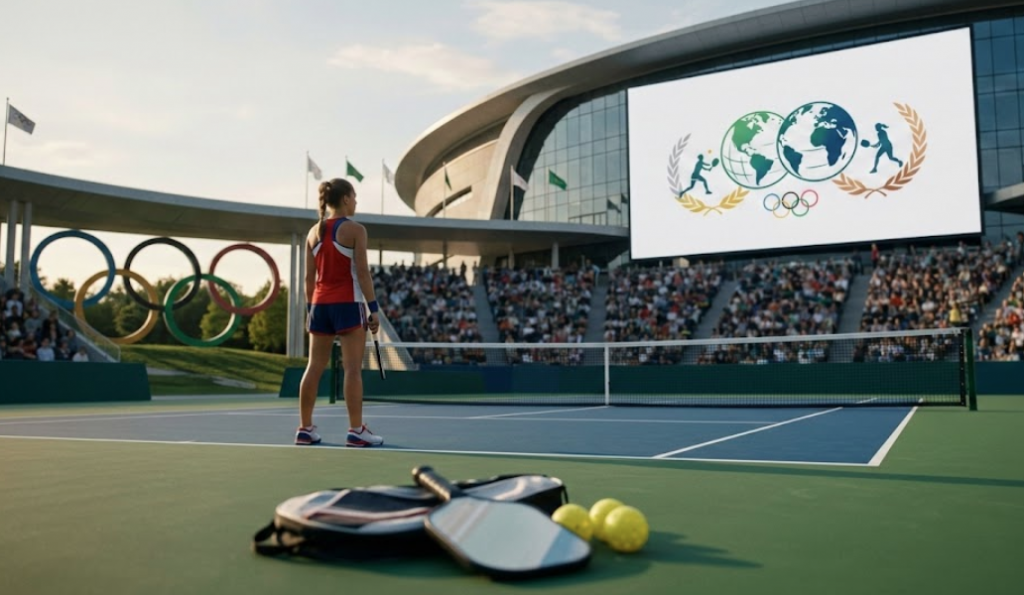
No, pickleball is not currently an Olympic sport and will not be included in the Los Angeles 2028 games. While the newly unified Global Pickleball Federation (GPF) has submitted paperwork for International Olympic Committee (IOC) recognition, the sport still needs to prove widespread global participation and establish a strict anti-doping program. The earliest realistic target for Olympic inclusion is Brisbane 2032, though 2036 or 2040 is more likely.
I have had many people ask me, “is pickleball an Olympic sport?” Not yet, my friends.
However, with the popularity of pickleball continuing its unstoppable rise, many avid players and fans believe the sport will one day make it to the Olympics. While we aren’t going to see it in the upcoming Los Angeles 2028 games, the dream is still very much alive for Brisbane 2032 and beyond!
Let’s dive into what it actually takes to become an Olympic sport, what’s happening behind the scenes, and why pickleball absolutely has what it takes to get there.
The Bureaucracy: What the IOC Actually Requires
To make it to the world’s biggest stage, the International Olympic Committee (IOC) has a pretty strict checklist. For a long time, pickleball had multiple competing organizations, which is a big red flag for the IOC. But we got some amazing news in June 2025: rival organizations finally put their differences aside to form the newly unified Global Pickleball Federation (GPF)!
The GPF has already submitted its IOC recognition paperwork, which is a massive first step. But there are still a few hurdles we need to clear:
- Global Expansion: The Olympic Charter requires a sport to be widely played in at least 75 countries for men and 40 for women. The GPF already claims over 100 member countries, which is a fantastic start! However, the IOC will want to see deep, functioning, competitive programs worldwide—especially for women. Right now, North America dominates the player base (the U.S. alone had over 13 million players in 2025!), so we need to keep spreading the love to Asia, Africa, and Europe to prove it’s a true global phenomenon.
- Anti-Doping Rules: You can’t have the Olympics without a strict, WADA-compliant anti-doping program. In December 2025, the GPF partnered with the International Testing Agency (ITA) to start building this out. It takes a few years to get fully compliant and establish a track record of clean competition, but we are actively building the foundation!
The Squash Precedent and the Honest Timeline
Getting into the Olympics takes time. Olympic sports governance moves at the pace of international bureaucracy, not at the lightning-fast speed of our favorite sport’s growth. For example, Squash checked almost every box and still waited over 40 years after getting IOC recognition before finally being approved for LA 2028!
Because of this, Brisbane 2032 is our earliest realistic opportunity. If everything aligns perfectly—host country support, global expansion, and clean testing records—we could see it there. Realistically, we might be looking at 2036 or 2040.
Why Pickleball Olympics Should Happen
Even with the long road ahead, pickleball is an ideal candidate for inclusion in the Olympics, which seeks to promote sports that are accessible to all. Here is why we’re so hopeful:
- Pickleball is played all over the world. And the international community is growing faster every day!
- It can be played indoors or outdoors, making it accessible in almost any climate.
- It’s fun! Unlike some other sports, pickleball doesn’t require hours of practice before you start to enjoy yourself. You can pick up the pickleball basics in minutes and be playing full games in no time.
- It keeps you fit without putting undue stress on your body, allowing players of all fitness levels to enjoy themselves without getting injured or exhausted.
- It’s the ultimate intergenerational sport. It’s excellent for families who want to play together because it’s easy for all ages, from young children to grandparents.
The Collegiate Pipeline
Another huge sign pointing toward the Olympics: the rapid rise of pickleball at the collegiate level. Several universities, including Stanford and the University of Florida, have embraced the sport, and the growth of college club teams has been phenomenal.
As the sport’s popularity continues to soar, there is real momentum for NCAA recognition. This is a key stepping stone, as many Olympic sports first gained their competitive footing at the collegiate level before making it to the world stage. The steadfast dedication of these college teams is laying the groundwork for elite international competition and future Olympic athletes.
Final Thoughts
So, is pickleball an Olympic sport? Not yet! We won’t be seeing it in LA 2028, and it might take until 2032 or 2036 to finally get that official Olympic ring status.
But the good news? The sport doesn’t need the Olympics to thrive. We love it for the community, the accessibility, and the sheer joy of playing. Olympic inclusion would be prestigious, and I truly believe we’ll get there, but pickleball will continue to survive, grow, and be a blast to play either way.
And finally, let’s talk about the elephant in the room: Anna Leigh Waters. It would be an absolute shame if the most dominant athlete in our sport’s history never gets the chance to step onto the Olympic podium in red, white, and blue. ALW was born in 2007. If pickleball manages to make its debut in Brisbane in 2032, she will be 25 years old—right in the absolute prime of her athletic career! Even if the bureaucratic tape pushes the timeline back to 2036 or 2040, she would still only be 29 or 33, leaving her with plenty of gas left in the tank to bring home gold for Team USA. Let’s just keep our fingers crossed that the international timeline catches up quickly enough for us to see our hometown hero shine on the world’s biggest stage!

Drew Pierce is a USA Pickleball Ambassador, PPR certified coach, and tennis crossover who covers beginner tips, paddle releases, and the sport’s growing culture. Read more on his About page or tune into Pickle Rock Radio.