
Last Updated on December 27, 2025 by Drew Pierce
A “Third Place” is a social environment separate from home (“First Place”) and work (“Second Place”) where people gather to connect. Sociologists argue that Pickleball has become the most effective modern Third Place because of its “Open Play” culture, which forces interaction between strangers, and its ability to act as a “Great Leveler”—where CEOs and retirees compete as equals. Recent studies show regular players are 60% less likely to report depression than non-players.
Pickleball players tend to fall hard for the sport.
The path to addiction is so quick that friends and families are often caught off guard.
There’s a reason many of us often hear, “Pickleball, again?!”
And it’s not said in the nicest of tones.
Well, I’m not sure about you, but it occurred to me recently that pickleball is my “third place.”
Coined by urban sociologist Ray Oldenburg, third places refer to venues we visit voluntarily and informally to enjoy people outside of the realms of home and work.
Home is the first place.
Work is the second place.
And for me, pickleball is the third place.
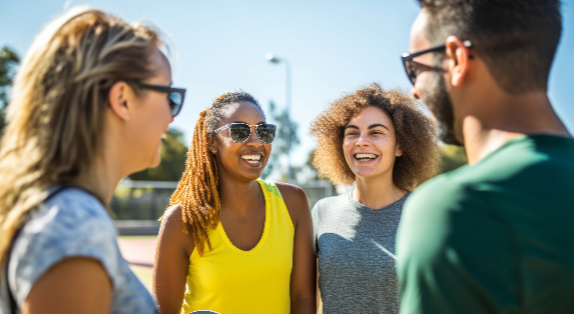
The third-place concept inspired Starbucks founder Howard Schultz. That’s why the coffee giant offers free WiFi, an attractive ambiance, and baristas who learn your name, all elements to create a place you want to spend time in. And ultimately, buy a $7 Iced Brown Sugar Oatmilk Shaken Espresso.
I can’t sit here and tell you that my local pickleball venues are as inviting as a Starbucks. Most of them smell like rubber and sweat. But here in New York, we don’t have the space or investment power, yet. However, when it comes to fostering community and connections, pickleball fits the third place like a round peg in a round hole.

Leagues, tournaments, lessons, clinics, and social events help bond people, many looking for connection in an increasingly isolating digital world. Having a regular place to gather and interact with other people fulfills the basic human need for social connection and belonging. As gratifying as home and work can be, that third place can be a real godsend. The community atmosphere combats loneliness. You look forward to seeing your pickleball friends.
I initially started playing pickleball for the exercise, but it’s the connections that keep me coming back for more.
Having a third place to come to has many benefits, including a change of environment, stimulation that provides personal growth, and a venue to recalibrate your mood and outlook.
Pickleball requires strategy, concentration and hand speed, all items that can quickly help you forget any drama at work or trauma from home. Playing the sport forces you to focus solely on the present moment. You can’t be worrying about other things when you’re trying to hit a ball coming at your face at 40mph, even if it made out of plastic. This mindful presence provides a mental break from stresses many of us experience at the first and second place.
In a sport already known for its third-shot drop, do we have enough room in our vernacular to call it the third place? And is it ironic that I want to come in first place at the third place?
| Feature | Coffee Shop | Gym | Pickleball Court |
|---|---|---|---|
| Interaction | Low (Headphones on) | Low (Solo focus) | |
| Cost | $5–$15 per visit | $50+ / month | Often Free / Low |
| Social Barrier | High (Awkward to talk) | High (Don’t disturb) | |
| Mood | Serious / Work | Focused / Intense | Playful / Laughter |
The 3 Reasons Pickleball is Better Than a Bar (According to Science)
Ray Oldenburg defined a “Third Place” by specific characteristics. Unlike a coffee shop where people wear headphones, Pickleball forces connection.
- The Great Leveler: Oldenburg argued that in a Third Place, “worldly status does not matter.” On the pickleball court, nobody cares what you do for a living; they only care if you can hit a third-shot drop. A CEO can lose to a grandmother, and that shared humility builds instant bonds.
- The “Open Play” Format: Most sports require you to bring your own friends. Pickleball’s unique “paddle stack” system means you must mix with strangers every 15 minutes. This creates what sociologists call “Weak Ties”—casual connections that are surprisingly vital for mental health.
- The Anti-Loneliness Data: A recent study from the Apple Heart & Movement Study found that regular pickleball players reported 60.1% lower odds of depression—a significantly higher protective benefit than tennis or walking.
Find Your Third Place (and Gear Up)
Ready to join the community? You don’t need much, but you do need a paddle that won’t embarrass you.
- To Find Courts: Use apps like PlayTime Scheduler or Pickleheads.
- To Make Friends: Bring a spare paddle! The Amazin’ Aces 2-Pack is perfect for lending to a newbie and starting a conversation. Being the person who brings someone else into the “Third Place” is the best feeling in the world.
Do you find that pickleball has become the third place in YOUR life?

Drew Pierce is a USA Pickleball Ambassador, PPR certified coach, and tennis crossover who covers beginner tips, paddle releases, and the sport’s growing culture. Read more on his About page or tune into Pickle Rock Radio.