
Last Updated on August 1, 2026 by Drew Pierce
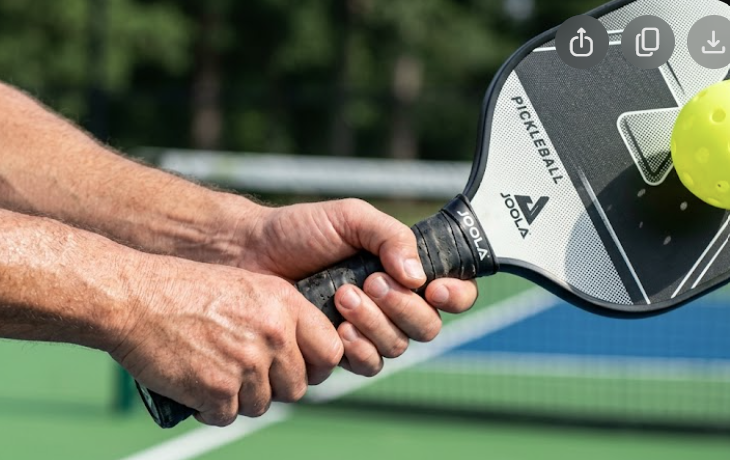
The two-handed backhand has gone from a tennis-transplant quirk to a legitimate weapon at the 4.0+ level, and in 2026 it is close to mandatory if you want to survive a kitchen-line firefight. Adding your non-dominant hand gives you stability on fast hands battles, real topspin on the third shot drive, and a roll volley that actually dips.
I need to start with a confession.
For my first two years in this sport, I was a one-handed backhand guy and proud of it. I came from tennis, I had a slice I liked, and I genuinely believed the two-hander was something tennis converts did because they hadn’t bothered to learn a proper pickleball backhand yet. I said this out loud. To people. Repeatedly.
Then I spent about six months getting handcuffed at the kitchen line by a 4.5 who did nothing but speed up at my right hip. Every single time, my one-handed backhand volley would either float or die. He knew it, I knew it, and by the fourth game he had stopped even pretending to hit anywhere else.
That’s when I finally added the second hand. And I want to be honest about the timeline: it made my game noticeably worse for about three weeks, and then it made my game dramatically better forever. If you’re on the fence, that’s the trade you’re actually considering.
Here’s everything I’ve learned since, including the gear mistake that made my first attempt miserable.
Why the Two-Handed Backhand Is Dominating in 2026
The modern game got faster. That’s the whole story, really.
Ten years ago pickleball at the rec level was a patience contest. You dinked, you waited, somebody eventually got bored and popped one up. Now, thanks to Gen 3 and Gen 4 foam-core paddles, everyone at 4.0 and above can generate serious pace from anywhere on the court. The rally isn’t decided by who is more patient. It’s decided by who wins the four-shot exchange that happens when somebody speeds it up.
A one-handed backhand slice is a fine shot. It is not a fast shot, and it is not a stable shot when a ball is coming at your chest at 45 miles per hour. That’s the gap the second hand fills.
The firefight advantage
This is the big one, and it’s the reason I switched.
When a hands battle starts at the kitchen line, you have maybe a third of a second to react. One hand on the paddle means your wrist is doing all the stabilizing work, and under that kind of pressure the paddle face wobbles. That wobble is why your “good” block sails long or drops into the net.
Two hands lock the face. Your non-dominant hand acts as a brace, and instead of absorbing the incoming pace with a floppy wrist, you’re absorbing it with your whole upper body. The difference in my counter-attack was immediate and a little embarrassing — I had been losing those exchanges for two years for a purely mechanical reason.
There’s also a durability argument that I didn’t expect. Research on backhand mechanics has found that the two-handed stroke distributes impact force across the elbow more evenly, while the one-hander loads it onto the forearm extensors — which is part of why lateral epicondylitis shows up more often in one-handed players. If you’re a player who has flirted with tennis elbow (raises hand), the second hand isn’t just offense. It’s insurance.
The third shot drive
The old gospel was third shot drop, always, no exceptions. That’s changed. At 4.0+, a lot of points now start with an aggressive third shot drive — a hard, topspin-heavy groundstroke intended to force a weak pop-up rather than to win outright.
The problem is that a one-handed backhand drive is hard to hit with topspin and consistency. You’re generating racket-head speed with one arm and hoping the face stays closed. With two hands, your non-dominant arm can pull through the shot, which means you can swing low-to-high aggressively without the face opening up on you.
My backhand third shot drive went from “shot I hit when I panic” to “shot I call before the return even lands.” That’s a real change in how I get to play points.
The roll volley
If the firefight advantage is why you should switch, the roll volley is why you’ll be glad you did.
The roll volley is that shot where you take a ball at or just above net height and brush up the back of it, hitting it hard while heavy topspin drags it down into the court. It’s the single most useful attacking shot in modern doubles, and it’s brutal to hit one-handed on the backhand side because you have to generate all that upward brush with your wrist.
With two hands, the brush comes from your torso and your non-dominant arm. You get more spin with less effort, which means you can hit it harder without the ball flying. This shot alone has probably added a couple hundred points to my DUPR.
Step-by-Step: How to Master the Two-Handed Backhand
Here’s the exact progression I’d give a student. Work through these in order — don’t skip to step three because you’re impatient, which is what I did and it cost me a month.
- Master the grip. Your dominant hand goes on the bottom of the handle in a continental grip — the “shaking hands with a hammer” position. Your non-dominant hand sits directly above it in an eastern forehand grip, because that top hand is essentially hitting a left-handed forehand (or right-handed, if you’re a lefty). The hands should touch. If there’s a gap, you’ll lose the connection between them and the shot falls apart. If your handle feels cramped with both hands on it, add an overgrip to build up the circumference and give yourself more cushion — I run a single tacky overgrip on mine for exactly this reason. If any of this grip terminology is new, my Ultimate Pickleball Grip Guide breaks down continental, eastern, and western in detail.
- Perfect the backswing. Turn your shoulders so your back is partially to your opponent, and take the paddle back with your arms relatively extended. Then keep it compact. I cannot stress this enough. The single most common error I see is players taking a full tennis backswing, which works fine on a 78-foot court and gets you eaten alive on a 44-foot one. Your backswing should stop roughly at your back hip. If your paddle disappears behind your body, it’s too big.
- Engage your hips and core. The power does not come from your arms. It comes from uncoiling your hips and torso, with your arms along for the ride. Try this: hit ten backhands using only your arms, then ten where you consciously drive your back hip through the shot. The second set will be faster with less effort, every time. This is the part that separates a two-hander that works from a two-hander that just looks like it should.
- Nail the contact point. Strike the ball out in front of your body — noticeably further in front than feels natural at first. Late contact is what forces your wrist to extend awkwardly, and it’s the mechanical flaw most associated with elbow trouble. If you’re consistently jamming yourself, you’re not turning early enough. Turn on the split step, not after the ball crosses the net.
- Finish over the opposite shoulder. For maximum topspin, brush low-to-high and let the follow-through carry the paddle up and over your dominant shoulder. A short, flat finish gives you a flat, dangerous shot. A high finish gives you a heavy ball that dips. When I’m struggling with backhand drives sailing long, it’s almost always because my finish got lazy and flat.
Drill it before you game it. Give yourself two weeks of feeding balls or wall work before you take this into open play, because the transition period is genuinely rough and there is no faster way to abandon a good technique than to lose six games in a row with it.
The Best Paddles for a Two-Handed Backhand (2026)
Now the part that nobody warned me about, and the reason my first attempt at this stroke was miserable.
A standard paddle handle is about 5 to 5.25 inches. Two adult hands do not fit on 5 inches. What actually happens is that your top hand rides up onto the paddle face — off the grip, off the bevels, and onto a surface with zero leverage and zero feel. You lose spin, you lose control, and you conclude the two-hander doesn’t work for you. It works fine. Your handle is too short.
You want a minimum of 5.3 inches, and I’d argue 5.5 inches is the real floor for anyone with average-to-large hands. Worth noting: USA Pickleball’s equipment rules cap combined paddle length and width at 24 inches with a max length of 17 inches, so manufacturers buying you handle length are usually spending it out of face width. That’s the trade — elongated paddles have longer handles and narrower faces, which means a smaller sweet spot horizontally. Worth it, in my opinion, but go in knowing.
Here are the two 2026 paddles I’ve put the most hours on, both of which I originally tested head-to-head in my Speedup Tide 14L vs. Selkirk Boomstik breakdown.
Comparison: Specs at a Glance
| Feature | Speedup Tide 14L | Selkirk Labs Boomstik (Elongated) |
|---|---|---|
| Price | $169.99 | $333.00 |
| Handle Length | 5.5″ – 5.7″ | 5.8″ |
| Core Material | MPP (Microcellular Polypropylene) | BoomCore (PureFoam + EVA Power Ring) |
| Swing Weight | 124.6 (very high / headsy) | ~118 (balanced) |
| Spin (RPM) | ~2,252 (elite) | ~1,980 (good) |
| Two-Handed Benefit | Elite spin grabs the ball for aggressive topspin drives | Shaves reaction time off your opponent’s game because the ball just explodes off the face |
Speedup Tide 14L — the spin play
At $169.99 this is the value pick, and the spin number is the headline. Roughly 2,252 RPM means the face genuinely grabs the ball, which is exactly what a two-hander wants: you’re already generating extra racket-head speed with the second arm, and a grippy face converts that speed into shape instead of into balls landing three feet past the baseline.
The 124.6 swing weight is very high for a 14mm paddle and it’s the thing you need to be honest with yourself about. It plows through the ball beautifully on drives. It is slower to whip around in a firefight. If you’re switching to a two-hander specifically because you’re losing hands battles, understand that you’re solving the stability problem while adding a maneuverability problem.
Selkirk Labs Boomstik Elongated — the power play
$333 is a lot of money for a pickleball paddle. I’ve said as much in print about a different overpriced paddle, so I’m not going to pretend otherwise here.
What you get for it is the longest handle in this comparison at 5.8 inches — genuinely roomy for two hands, even with an overgrip — and a foam core that doesn’t need a break-in period and doesn’t core-crush after two months. The ball leaves this paddle. The tactical value of that with a two-handed backhand is that you can hit a controlled, compact stroke and still produce a ball that arrives before your opponent has reset, which is the entire point of the roll volley.
Spin is a step below the Tide at around 1,980 RPM. That’s still good, just not elite. Pick your poison: shape or speed.
If you’re coming from tennis and want a broader look at how paddle shape maps onto tennis mechanics, I went deep on that in my guide to picking a pickleball paddle as a tennis player.
Frequently Asked Questions
Can I hit a two-handed backhand with a standard paddle? You can, but it’s a compromise. Standard handles run about 5 inches, which forces your non-dominant hand to sit partially on the paddle face rather than the grip. That costs you leverage, control, and feel, and it’s the single most common reason players try the two-hander and give up on it. If you want to test the stroke before buying a new paddle, choke your bottom hand down to the very base of the handle to buy yourself a bit of room — just know that a longer handle will feel dramatically better.
When should I use a one-handed slice instead? Keep the one-hander. Seriously. A one-handed slice with undercut is still the right shot for defensive resets, for balls you have to stretch wide for, and for low dinks outside your reach — the second hand physically limits how far you can extend. The best 4.0+ players I know use both: two hands when they have time and want to attack, one hand when they’re stretched or scrambling. Treat the two-hander as an addition to your toolkit, not a replacement for what already works.
Will a heavier swing weight help my two-hander? Generally yes. A higher swing weight like the Tide 14L’s 124.6 gives you real plow-through, meaning the paddle keeps moving through contact instead of getting pushed back by the incoming ball. Since your second hand is already generating extra racket-head speed, you can handle more mass than you could one-handed. The tradeoff is hand speed in quick exchanges, so if you play primarily at the kitchen line, look for something in the 115–118 range instead.
How long does it take to learn? In my experience and with the students I’ve worked through it: about three weeks of feeling worse, then a permanent improvement. Give it a month of consistent use before you judge it. If you’re currently working through the jump from 3.5 to 4.0, this stroke pairs well with the other changes that matter at that level — I wrote about that whole transition in how to advance from 3.5 to 4.0.
The Bottom Line
I spent two years telling people the two-handed backhand was a crutch for tennis players who hadn’t learned the real thing. I was wrong, and specifically I was wrong about the mechanics: the second hand isn’t a substitute for technique, it’s a stability system that makes modern pickleball’s fastest exchanges survivable.
Get a paddle with a real handle. Drill it for two weeks before you play with it. Keep your one-handed slice for the stretch balls. And be patient through the ugly part, because on the other side of it is a backhand that your opponents will stop targeting.
Now if you’ll excuse me, I owe a 4.5 in my Tuesday group an apology and a rematch.

Drew Pierce is a USA Pickleball Ambassador, PPR certified coach, and tennis crossover who covers beginner tips, paddle releases, and the sport’s growing culture. Read more on his About page or tune into Pickle Rock Radio.