
Last Updated on October 14, 2026 by Drew Pierce
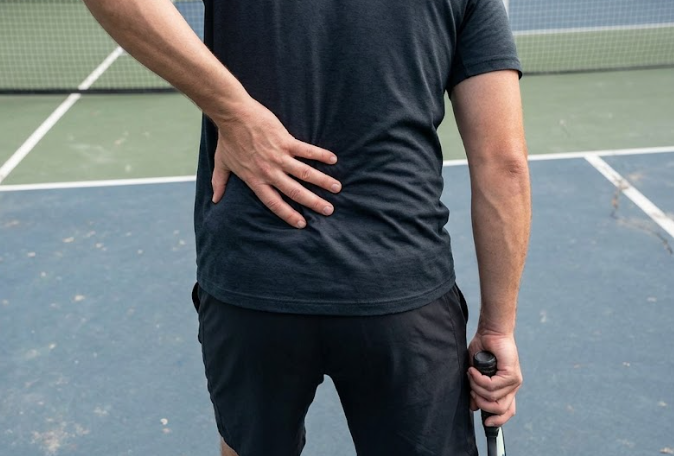
Yes, pickleball can cause lower back pain. In a 2025 survey of 1,758 U.S. players, about 1 in 5 reported a back complaint in the past year. Repeated low bending, twisting, long sessions and falls are the usual culprits. Bend your knees, not your waist, warm up and add court time gradually. Leg numbness, weakness or bladder changes mean see a doctor.
I left tennis for pickleball because of my lower back. It’s right there on my About page: my body, “specifically my lower back (SI JOINT!),” was starting to protest.
Pickleball looked like the fix. Smaller court. Underhand serve. Way less running. Easy mode.
It wasn’t. By early 2023 I was admitting it in my injury roundup: pickleball is easier on my body overall, but “it’s not any better for my lower back–in fact, it might be worse!”
So this isn’t a “pickleball is gentle, come on in” post. It’s what the research actually shows, which habits medical sources back, and where I’m just telling you what I do.
One thing up front: I’m not a clinician. None of this is medical advice.
Quick answer
- Back complaints are common. Back was the fourth most-reported spot (19.9%) in a 2025 nationwide player survey.
- Bend at the knees. The AAOS lifting advice meant for boxes works just as well for dinks and ball pickups.
- Warm up, then ramp up. AAOS, UC Davis Health and a Mayo Clinic surgeon all hammer this.
- Know the red flags. Leg weakness, numbness in both legs, bladder or bowel changes, fever, or pain after a fall all need prompt care.
Is pickleball bad for your back?
Not “bad.” But your back is clearly on the list. Here’s what the numbers say, and what they don’t.
- The big player survey. A 2025 Sports Medicine – Open study asked 1,758 U.S. players (average age about 63) about complaints over the previous 12 months. Back landed at 19.9%, behind the knee, the thigh/leg/foot and the shoulder. It’s self-reported, so it counts nagging aches as well as diagnosed injuries.
- Emergency rooms. A 10-year emergency department analysis (Orthopaedic Journal of Sports Medicine, January 2025) ranked the “lower trunk” second, at 12.1% of injuries. Read that one carefully. The category lumps the lower back in with the hip and pelvis, and falls caused 65.5% of all the injuries.
- Clinics. A Vanderbilt study (February 2025) found back pain or strain in 7.8% of 618 pickleball injuries. A 2025 JAAOS spine study found 8.8% of one urban center’s pickleball orthopedic injuries involved the spine, and 84% of those were lumbar. The most common complaint was pain radiating down the leg.
Rookie note, and this one stung a little: in that survey, players with under five years of experience, and people who played more days a week, had higher odds of injury overall. Not back-specific. But if you found pickleball last spring and now play six days a week, I see you.
Why does pickleball make my lower back hurt?
Baptist Health describes the pattern well. A ball skims low, you bend to dig it out, you pop back into your ready stance. Then you do it again, dozens of times a match.
Stack these on top:
- Hours on court. Dr. Joshua Dines, an HSS surgeon and (as of 2024) Major League Pickleball’s medical director, told Spectrum News in 2024: “Now we’re playing a racket sport for hours upon hours a week, and that just leads to overuse injuries [like] tennis elbow, sore shoulders, back injuries.”
- Twisting under load. AAOS lists lifting, pulling, bending or twisting as activities after which a herniated disk may show up.
- Falls. For players with osteoporosis, AAOS notes that even a ground-level fall can cause a spinal compression fracture.
In March 2022, after one of my early open plays, I wrote that my lower back felt “a bit more aggravated than usual” and blamed “the quick ducking for low balls.” I didn’t know it yet, but that was the whole problem in one sentence.
Is pickleball easier on your back than tennis?
Honest answer: nobody’s measured it. I went looking for a study comparing lower-back load in tennis and pickleball. I couldn’t find one.
Here’s what we do know.
- The tennis serve is a known back stressor. A 2013 Medicine & Science in Sports & Exercise study of elite teenage tennis players measured side-bending forces in the lower back during the serve at roughly eight times those in running. Those forces showed up together with extension and rotation, which the authors flagged as a possible low-back-pain mechanism.
- Pickleball takes that serve away. The 2026 USA Pickleball rulebook requires an upward arc and contact no higher than the waist on a volley serve (Rule 7.C). A drop serve is legal too. An APTA Orthopedics physical therapist notes that many pickleball shots happen with the shoulder below 90 degrees.
- But the low ball replaces it. Mayo Clinic hand surgeon Dr. Sanj Kakar points out that the ball doesn’t bounce as high, and calls the motion “more violent than, I would say, tennis.” He wasn’t talking about backs. Still, low balls are exactly where us tennis converts fold at the waist, because we spent years hitting balls that sat up at hip height.
So you trade an overhead, arched-back serve for dozens of low, crouched contacts. Which one your back hates more depends on your back.
What if it’s my SI joint?
Your sacroiliac (SI) joints are where your spine meets your pelvis. Mine get a lot of mentions on this site.
Cleveland Clinic says inflammation there (sacroiliitis) can cause pain that:
- gets worse after sitting or standing a long time, or when you turn or rotate your hips
- spreads into the buttock, hip or thigh
Harvard Health adds that SI pain often sits slightly to one side and can look a lot like a herniated disc or sciatica. Which is exactly why you can’t diagnose it from a blog post. Including this one.
An American Family Physician review (2022) says SI dysfunction can build gradually from sports with repeated “shear or torsional forces.” It lists physical therapy exercise programs as a first-line treatment.
I’ve written about my “damaged sacroiliac joints” before. What keeps my back on the court isn’t a plan for yours. Get evaluated.
How do I protect my lower back on the court?
| Court moment | What it asks of your back | Habit to try |
|---|---|---|
| Dinks and low volleys | Repeated bending | Knees and hips do the lowering (AAOS lifting guidance) |
| Picking up balls | Dozens of extra bends | AAOS one-leg-back pickup, or a ball retriever |
| Lobs over your head | Backward falls | Turn and move. Don’t backpedal |
| First 10 minutes | Cold tissue | Warm up, then easy hitting first (AAOS) |
| Hour three | Fatigue, overuse | Breaks, rest days, gradual ramp (UC Davis Health) |
Lower yourself with your legs. AAOS says “bend at the knees” and “do not bend at your waist.” At the kitchen, that means a wider base and bent knees, so the paddle gets low without your spine folding in half. My ready position guide covers the stance.
Stop bending for every ball. For light objects, AAOS suggests leaning over, bending one knee and extending the other leg behind you while holding something sturdy. Think golfer plucking a ball out of the cup. Ball retrievers and the paddle-and-foot scoop are common court habits, not studied ones. They’re just fewer bends, and you’ll make a lot of bends over a three-hour open play.
Don’t backpedal for lobs. Falls drive most pickleball ER visits. Turning sideways and moving back, instead of stumbling backward with your eyes on the sky, is a standard coaching cue. Or let some lobs go. Nobody’s handing out trophies at open play.
Warm up, then ease in. AAOS recommends light calisthenics, stretches and easy hitting drills before going all-out. UC Davis Health adds dynamic stretching, light cardio and building session length gradually.
My own pre-game routine is five minutes on a heating pad when I can swing it, light floor stretches, jogging in place, then the Chirp Wheel. That’s my routine, not a prescription. (The NHS does note a wrapped heat pack can ease stiffness or muscle spasms.) Full sequence is in my warm-up routine.
Wear court shoes. HSS surgeon Dr. Carl Cirino says running shoes have a curve that propels you forward, while pickleball needs a stable flat base. AAOS also says to choose pickleball or tennis shoes.
Build the engine off the court. UC Davis Health recommends strengthening your shoulders, core and legs, about 150 minutes a week of other exercise, and one rest day a week. My pickleball fitness post has a starting list. If your back already hurts, let a PT pick your exercises.
When should I see a doctor or physical therapist?
Still not medical advice. Here’s when the experts say to get help.
Get care right away (urgent or emergency) if you have back pain with:
- weakness in your legs
- pain, tingling, weakness or numbness in both legs
- numbness around your genitals or anus
- loss of bladder or bowel control, or difficulty peeing
- pain that started after a hard fall or other serious accident
- fever, chills, or feeling hot, cold and shivery
Call your doctor soon if:
- the pain isn’t improving after a few weeks
- you’ve lost weight without trying
- it’s worse at night or doesn’t ease with rest
- it’s stopping your daily activities
Sources: AAOS OrthoInfo and the NHS (reviewed March 2026). If you have weak bones, take any fall seriously. For SI-type pain, Cleveland Clinic says to see a provider if it doesn’t improve on its own within a week.
Final thoughts
Pickleball didn’t fix my back. It just handed it a different set of problems.
Bend with your legs. Skip the backpedal. And when your legs start talking, get help.
For the bigger injury picture, start with the 11 most common pickleball injuries.
Pickleball back pain FAQ
Is pickleball bad for your back? Not inherently. But about 1 in 5 players in a 2025 survey reported a back complaint over 12 months.
Can I play pickleball with lower back pain? That’s a call for your doctor or PT, especially if the pain is new, severe or spreading. The NHS generally advises staying active rather than resting in bed, but stopping an exercise if it makes the pain worse.
Can pickleball cause sciatica? Leg pain linked to the spine does show up in pickleball clinics. In one 2025 spine study, pain radiating down the leg was the most common complaint. Pain, numbness or weakness running down your leg needs a medical evaluation.
Should I play pickleball with SI joint pain? Get it diagnosed first. SI pain can mimic disc problems and sciatica, and physical therapy is a first-line treatment. Ask your PT which movements to limit.
What shoes are best for pickleball if I have back pain? Court shoes with a flat, stable base, not running shoes. No shoe treats back pain, though, whatever the box says.
Does a lighter paddle help back pain? I couldn’t find research linking paddle weight to lower back pain. Medical sources focus on technique and volume. So before you buy another paddle to fix your back (I know the feeling), fix the bend.

Drew Pierce is a USA Pickleball Ambassador, PPR certified coach, and tennis crossover who covers beginner tips, paddle releases, and the sport’s growing culture. Read more on his About page or tune into Pickle Rock Radio.