
Last Updated on September 24, 2026 by Drew Pierce
For a long time, I thought paddle shopping was a personality test.
Are you a power guy? A spin gal? A control person who pretends they don’t want either?
The paddle industry is always trying to please everybody.
For a few years, the easiest way to sell a $300 paddle was to promise more. More pop. More exit speed. More of that hollow thwack that makes you feel athletic even when all you did was block a ball.
Then foam cores showed up, and the marketing got even louder.
Selkirk Labs put the Boomstik out at $333, and people talked about it like it was a lifestyle. Tesla put gold geometry on a paddle and sold the vibe. I wrote about the Tesla Aurum when it dropped. Owning a paddle that matches your Cybercab is a choice.
It is not a third-shot drop.
Eventually, the governing bodies did what governing bodies do when the equipment starts winning points on its own.
The Pickleball Spin Cap: What Changes on October 1, 2026
Power already got its ceiling.
USA Pickleball’s PBCoR test, which is basically the lab number for how much trampoline you get off the paddle face, dropped to a 0.43 cap on November 1, 2025. UPA-A, which governs what the pros play at the PPA and MLP, uses a different acronym (PEF) for the same idea.
There’s a lid on rebound.
Spin is next.
Starting October 1, 2026, a week from today, every new paddle submitted to USA Pickleball has to measure 2,100 RPM or less on an actual spin-rate test. The old way measured how rough the face was and used that as a stand-in for spin. The new test uses high-speed cameras to watch the ball rotate off the paddle.
It’s a real number now.
There are two things the headlines tend to bury.
- Your current paddle is still legal. If it was certified under the old roughness and friction rules, it stays approved. This changes what gets certified going forward. Nobody is coming to confiscate paddles at open play.
- The cap applies to the lab test, not your swing. A 4.0 who has learned to brush low-to-high will still out-spin a 3.0 holding a “2,200 RPM” paddle like a hammer. I know because I was the hammer.
UPA-A has been living with a 2,100 RPM ceiling for a while now. Rec play is just catching up to the pro rulebook, which is how this sport usually works.
We copy the toys first.
We copy the limits later.
So no, spin is not dead. Grit as a cheat code is just getting a governor.
JOOLA’s First Foam Paddle Launches the Day Before the Spin Test
JOOLA spent most of the foam boom looking at it from a distance.
When they launched the Pro V line back in February, everyone was asking the same question I was: great paddle, but where’s the foam? Their answer, more or less, was that they would release foam when it felt like a JOOLA paddle and not a copy of everybody else’s Gen-4 press release.
Fair.
Also convenient.
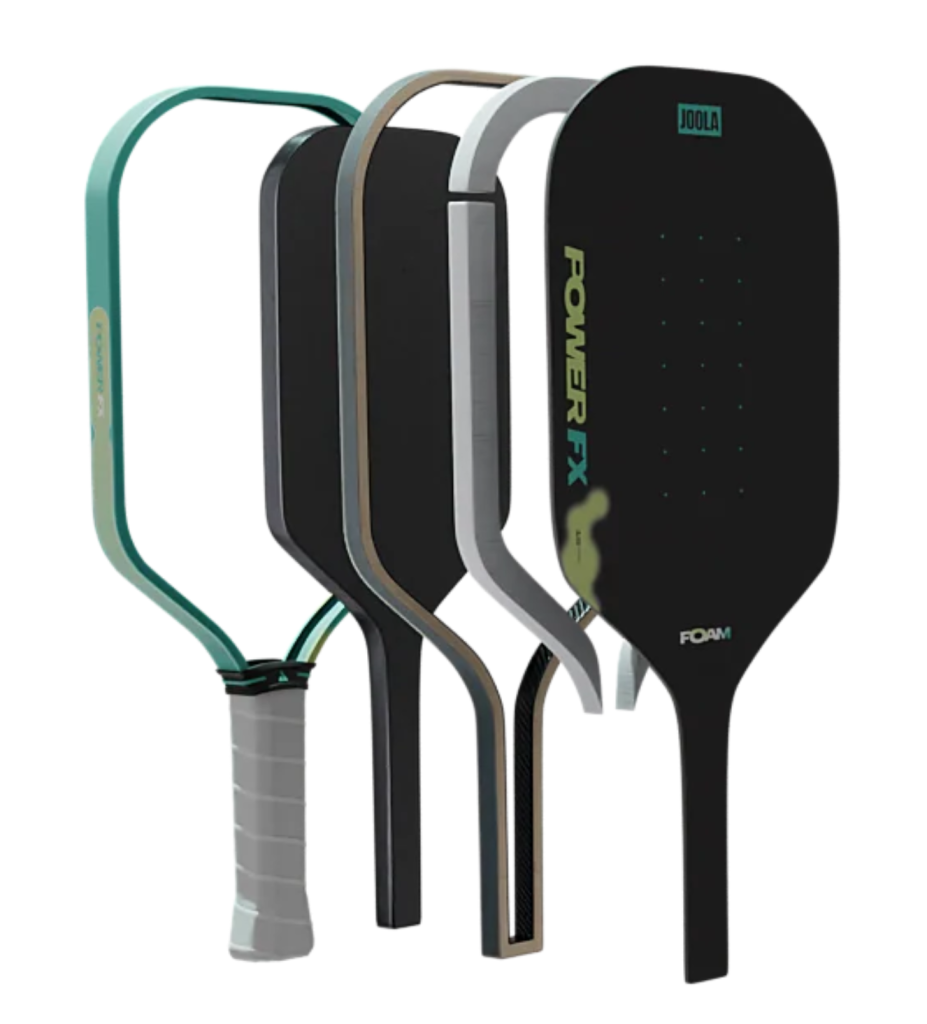
On September 30, they finally put one on the shelf. The JOOLA POWER FX is the first JOOLA paddle built as a foam paddle, as opposed to a honeycomb core with some foam injected around the edges and called a “system.”
Here’s what we actually know, as opposed to what the landing page wants us to feel:
- Price: $179.95. That’s the story. The Boomstik is $333. The Tesla Aurum was $295 and sold out so it could live on Facebook Marketplace. JOOLA’s own Pro V paddles sit near $300. This one is priced like somebody at JOOLA noticed the rest of us play on public courts.
- Thickness: 16mm. Standard modern thickness. Not a thin 14mm pop stick, not a board.
- Shape: Perseus. Elongated. If you’ve ever seen Ben Johns walk around with a JOOLA, you know the silhouette.
- Colorway: Daydream (green/teal). I don’t have a take on the paint.
- Construction: EPP foam, JOOLA’s patented Propulsion Core, and an “optimized surface layup.” Translation: they put foam inside the thing they already patented and then told us they didn’t rush it.
Austin Kim, JOOLA’s Director of Product, said the POWER FX is “the first one where both power and the feel showed up in the same paddle.” Gordon Kaye, their Chief Experience Officer, said everyone deserves power, not just the pros on tour.
I believe the price more than I believe the poetry.
And I haven’t hit this paddle yet.
I’m not going to review a sweet spot from a product page. I’ve already made that mistake. Last summer, I bought the “best reviewed” cheap set for a Delaware trip, then a Prince for over a hundred dollars. If there was a difference between them, it was the kind you invent after you look at the receipt.
Should You Buy the JOOLA POWER FX? What I’d Do With $180
I play with a two-handed backhand now. That means I care about handle length before I care whether the paddle shape is named after a Greek hero.
The Speedup Tide 14L I wrote about has a 5.5 to 5.7-inch handle and enough spin that the ball stays on the face long enough for the second hand to matter. The Boomstik elongated has room and explosion, plus a price that makes me look at my DUPR and laugh.
JOOLA hasn’t published the POWER FX handle length in anything I’ve seen. A Perseus-shaped JOOLA is usually in two-hand territory.
But “usually” is how you buy the wrong paddle twice.
So here’s my rule this week.
Don’t buy JOOLA’s first foam paddle just because you got tired of waiting.
Buy it if you can demo it, if the handle doesn’t cramp your top hand, and if it still makes sense after October 1, when “max spin” is no longer a legal selling point.
If your paddle was approved before the new test, you’re not behind. You’re grandfathered. The ones who should feel urgency are the brands still selling last year’s unlimited-grit story as their 2027 plan.
Why a Power and Spin Ceiling Is Good for Rec Players
Honestly, a lid on power is good news.
Call me crazy, but I like rallies.
When everybody’s paddle is a cannon, every point turns into a race to the first speed-up. When the cannon has a lid, the kitchen matters again. Dinks matter.
That’s the unsexy version of this story. USA Pickleball didn’t kill innovation. They made it harder to buy a winner and a little easier to learn one.
Spin will still separate players. The reviewers who publish RPM lists will still argue about whose cannon is more scientific. Some paddles already test near or over 2,100 in independent labs, but that’s a different protocol than USA Pickleball’s, which is also different from what happens when I wrist a ball at 8:15 on a Tuesday night.
Don’t compare those charts like they’re SAT scores.
What I Want in My Next Pickleball Paddle
My wish list has gotten a lot shorter.
- A handle long enough for two hands, so my top hand isn’t riding up onto the throat
- Spin that lasts more than a month, because grit that dies is just a $180 sanding block
- Enough pop to punish a high ball without turning every block into a pop-up
- A price I don’t have to explain to myself in the parking lot
The POWER FX is clearly aiming at that last one, and I’ll give JOOLA credit for it. Whether it delivers on the first three is a question for the court.
The court opens September 30.
Final Thoughts on the JOOLA POWER FX and the Spin Cap
I’m not dumping my bag next week.
But I’m paying attention.
If I can find the POWER FX on a demo wall before I spend $180, I will. I’ll check the handle first, the foam second and the colorway never.
If I can’t demo it, I’ll keep playing the paddles I already trust. The Tide when I want the ball to grab. The Boomstik when I want a reminder that even premium foam has a ceiling. And I’ll keep an eye on which new paddles get certified after October 1, because those are the ones built for the sport we’re about to play.
The power era didn’t end.
It just got a speed limit.
And that’s fine with me. I was never going to out-pop the guys who live at the kitchen line. My job is to keep the ball low, loosen my grip, and stop arguing with a two-handed backhand that was trying to save me all along.
If you’ve already preordered a POWER FX, tell me in the comments what you’re hoping it fixes. And if you’re sitting this one out because your current paddle still works, you’re not a Luddite.
JOOLA POWER FX and Spin Cap FAQ
When does the JOOLA POWER FX come out?
September 30, 2026, at JOOLA and retailers nationwide, for $179.95.
Is the JOOLA POWER FX a full-foam paddle?
Yes. It’s JOOLA’s first paddle built with foam construction, using EPP foam inside its patented Propulsion Core, with a 16mm core and an elongated Perseus shape.
What is the USA Pickleball 2,100 RPM spin limit?
Starting October 1, 2026, any paddle submitted for USA Pickleball certification must measure 2,100 RPM or less on a camera-based spin-rate test. It replaces the old surface roughness and friction limits and matches the number UPA-A already uses.
Will my current paddle become illegal after October 1?
No. Paddles certified under the old standards stay approved. The new test only applies to paddles submitted from October 1 on.

Drew Pierce is a USA Pickleball Ambassador, PPR certified coach, and tennis crossover who covers beginner tips, paddle releases, and the sport’s growing culture. Read more on his About page or tune into Pickle Rock Radio.